
India’s Ramsar Sites Reach 103: New Additions, Complete Year-Wise List, and Competitive Exam Study Notes
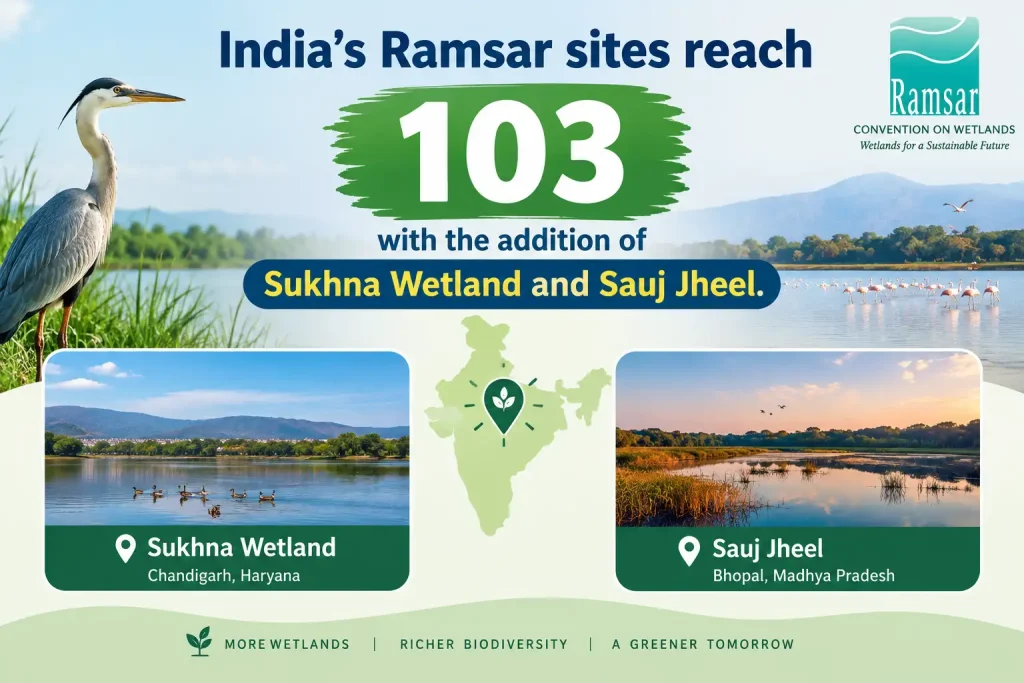
In a historic environmental milestone, India’s Ramsar sites reach 103 following the official designation of two critical wetland ecosystems under the Ramsar Convention on Wetlands[cite: 1]. The Ministry of Information and Broadcasting confirmed the addition of Sukhna Wetland located in Chandigarh and Sauj Jheel situated in Uttar Pradesh[cite: 1]. With these inclusions, India firmly maintains the largest network of Ramsar wetlands in South Asia, highlighting its commitment to biodiversity conservation, sustainable water security, and ecological restoration[cite: 1].
For competitive examination aspirants preparing for UPSC Civil Services, TNPSC Group 1, Group 2/2A, Group 4, SSC CGL, and other State PSC exams, wetland ecology and international conservation pacts represent high-priority syllabus topics. This verified study guide breaks down the newest additions, offers a complete chronological registry of all 103 declared sites, clarifies Montreux Record criteria, and solves previous official examination questions.
Understanding Wetland Conservation and the Ramsar Convention Framework
The Ramsar Convention on Wetlands is an international treaty adopted on February 2, 1971, in Ramsar, Iran. It took effect globally in 1975, while India formally ratified and acceded to the convention on February 1, 1982. Wetlands function as dynamic ecological transitional zones between terrestrial and aquatic systems. Termed the "biological kidneys of the landscape," they filter toxins, regulate seasonal floods, recharge deep aquifers, and sequester carbon far more effectively per unit area than standard terrestrial forests.
Under the international mandate, designated sites of international importance require national conservation frameworks, ecological character monitoring, and strict regulation against invasive degradation, illegal encroachment, and industrial contamination.
In-Depth Profile of the Two Newly Added Wetlands
1. Sukhna Wetland (Union Territory of Chandigarh)
Sukhna Wetland is a scenic rain-fed reservoir created originally in 1958 by damming the Sukhna Choe at the foothills of the Shivalik range[cite: 1]. It serves as a vital winter haven for migratory waterfowl along the Central Asian Flyway[cite: 1]. The site acts as a key flood mitigation basin and local water regulator for the city while sheltering diverse avian and freshwater aquatic species[cite: 1].
2. Sauj Jheel (Mainpuri District, Uttar Pradesh)
Sauj Jheel is a natural freshwater wetland ecosystem recognized as a significant breeding and staging ground for the Sarus Crane (Antigone antigone), the state bird of Uttar Pradesh[cite: 1, 3]. Beyond supporting vulnerable avian life, this wetland buffers local agricultural fields against flash runoff and provides groundwater recharge across the Gangetic plains[cite: 1, 3].
Ecological Significance as India’s Ramsar Sites Reach 103
The strategic milestone where India’s Ramsar sites reach 103 reflects a decades-long expansion that accelerated under initiatives like Mission Amrit Sarovar and the Amrit Dharohar framework[cite: 1, 3]. Wetlands across India represent distinct eco-regions ranging from the high-altitude glacial waters of Ladakh and Himachal Pradesh to the saline mangrove habitats of the Sundarbans and the shallow temple tanks of Tamil Nadu.
Ensuring Ramsar status enhances global recognition, attracts specialized ecological funding, promotes community-led eco-tourism, and introduces systematic hydrological assessments to prevent rapid siltation and eutrophication.
Official Chronological List: All 103 Ramsar Sites in India (1981–2026)
The table below provides the full, year-by-year chronological sequence of all 103 designated Ramsar sites across India, detailing their home State or Union Territory[cite: 1]:
| Year | Name of Ramsar Site | State / Union Territory |
|---|---|---|
| 1981 | Chilika Lake | Odisha |
| 1981 | Keoladeo National Park | Rajasthan |
| 1990 | Harike Wetland | Punjab |
| 1990 | Loktak Lake | Manipur |
| 1990 | Sambhar Lake | Rajasthan |
| 1990 | Wular Lake | Jammu & Kashmir |
| 2002 | Ashtamudi Wetland | Kerala |
| 2002 | Bhitarkanika Mangroves | Odisha |
| 2002 | Bhoj Wetland | Madhya Pradesh |
| 2002 | Deepor Beel | Assam |
| 2002 | East Kolkata Wetlands | West Bengal |
| 2002 | Kanjli Wetland | Punjab |
| 2002 | Kolleru Lake | Andhra Pradesh |
| 2002 | Point Calimere Wildlife and Bird Sanctuary | Tamil Nadu |
| 2002 | Pong Dam Lake | Himachal Pradesh |
| 2002 | Ropar Wetland | Punjab |
| 2002 | Sasthamkotta Lake | Kerala |
| 2002 | Tsomoriri (Tso Moriri) Lake | Ladakh |
| 2002 | Vembanad-Kol Wetland | Kerala |
| 2005 | Chandertal Wetland | Himachal Pradesh |
| 2005 | Hokersar Wetland | Jammu & Kashmir |
| 2005 | Renuka Wetland | Himachal Pradesh |
| 2005 | Rudrasagar Lake | Tripura |
| 2005 | Surinsar-Mansar Lakes | Jammu & Kashmir |
| 2005 | Upper Ganga River (Brijghat to Narora Stretch) | Uttar Pradesh |
| 2012 | Nalsarovar Bird Sanctuary | Gujarat |
| 2019 | Sundarban Wetland | West Bengal |
| 2019 | Beas Conservation Reserve | Punjab |
| 2019 | Keshopur-Miani Community Reserve | Punjab |
| 2019 | Nangal Wildlife Sanctuary | Punjab |
| 2019 | Nawabganj Bird Sanctuary | Uttar Pradesh |
| 2019 | Parvati Arga Bird Sanctuary | Uttar Pradesh |
| 2019 | Saman Bird Sanctuary | Uttar Pradesh |
| 2019 | Samaspur Bird Sanctuary | Uttar Pradesh |
| 2019 | Sandi Bird Sanctuary | Uttar Pradesh |
| 2019 | Sarsai Nawar Jheel | Uttar Pradesh |
| 2019 | Nandur Madhameshwar | Maharashtra |
| 2020 | Asan Conservation Reserve | Uttarakhand |
| 2020 | Kanwar (Kabar) Taal Lake | Bihar |
| 2020 | Lonar Lake | Maharashtra |
| 2020 | Sur Sarovar (Keetham Lake) | Uttar Pradesh |
| 2020 | Tso Kar Wetland Complex | Ladakh |
| 2021 | Sultanpur National Park | Haryana |
| 2021 | Bhindawas Wildlife Sanctuary | Haryana |
| 2021 | Thol Lake Wildlife Sanctuary | Gujarat |
| 2021 | Wadhvana Wetland | Gujarat |
| 2021 | Haiderpur Wetland | Uttar Pradesh |
| 2022 | Khijadiya Bird Sanctuary | Gujarat |
| 2022 | Bakhira Wildlife Sanctuary | Uttar Pradesh |
| 2022 | Karikili Bird Sanctuary | Tamil Nadu |
| 2022 | Pallikaranai Marsh Reserve Forest | Tamil Nadu |
| 2022 | Pichavaram Mangrove | Tamil Nadu |
| 2022 | Sakhya Sagar | Madhya Pradesh |
| 2022 | Pala Wetland | Mizoram |
| 2022 | Koonthankulam Bird Sanctuary | Tamil Nadu |
| 2022 | Satkosia Gorge | Odisha |
| 2022 | Nanda Lake | Goa |
| 2022 | Gulf of Mannar Marine Biosphere Reserve | Tamil Nadu |
| 2022 | Ranganathittu Bird Sanctuary | Karnataka |
| 2022 | Vembannur Wetland Complex | Tamil Nadu |
| 2022 | Vellode Bird Sanctuary | Tamil Nadu |
| 2022 | Sirpur Wetland | Madhya Pradesh |
| 2022 | Vedanthangal Bird Sanctuary | Tamil Nadu |
| 2022 | Udhayamarthandapuram Bird Sanctuary | Tamil Nadu |
| 2022 | Tampara Lake | Odisha |
| 2022 | Hirakud Reservoir | Odisha |
| 2022 | Ansupa Lake | Odisha |
| 2022 | Yashwant Sagar | Madhya Pradesh |
| 2022 | Chitrangudi Bird Sanctuary | Tamil Nadu |
| 2022 | Vaduvur Bird Sanctuary | Tamil Nadu |
| 2022 | Kanjirankulam Bird Sanctuary | Tamil Nadu |
| 2022 | Suchindram Theroor Wetland Complex | Tamil Nadu |
| 2022 | Thane Creek | Maharashtra |
| 2022 | Hygam Wetland Conservation Reserve | Jammu & Kashmir |
| 2022 | Shallabugh Wetland Conservation Reserve | Jammu & Kashmir |
| 2024 | Ankasamudra Bird Conservation Reserve | Karnataka |
| 2024 | Aghanashini Estuary | Karnataka |
| 2024 | Magadi Kere Conservation Reserve | Karnataka |
| 2024 | Karaivetti Bird Sanctuary | Tamil Nadu |
| 2024 | Longwood Shola Reserve Forest | Tamil Nadu |
| 2024 | Nagi Bird Sanctuary | Bihar |
| 2024 | Nakti Bird Sanctuary | Bihar |
| 2024 | Tawa Reservoir | Madhya Pradesh |
| 2024 | Nanjarayan Bird Sanctuary | Tamil Nadu |
| 2024 | Kazhuveli Bird Sanctuary | Tamil Nadu |
| 2024–2026 | Patna Bird Sanctuary | Uttar Pradesh |
| 2024–2026 | Shekha Jheel Bird Sanctuary | Uttar Pradesh |
| 2024–2026 | Kopra Reservoir | Chhattisgarh |
| 2024–2026 | Gogabeel Lake | Bihar |
| 2024–2026 | Gokul Reservoir | Bihar |
| 2024–2026 | Udaypur Lake | Bihar |
| 2024–2026 | Chhari-Dhand | Gujarat |
| 2024–2026 | Udhwa Lake | Jharkhand |
| 2024–2026 | Khichan Wetland | Rajasthan |
| 2024–2026 | Menar Wetland Complex | Rajasthan |
| 2024–2026 | Siliserh Lake | Rajasthan |
| 2024–2026 | Khecheopalri Wetland | Sikkim |
| 2026 | Jai Prakash Narayan Bird Sanctuary (Surha Tal) | Uttar Pradesh |
| 2026 | Glaw Lake | Arunachal Pradesh |
| 2026 | Sukhna Wetland 102nd Site | Chandigarh[cite: 1] |
| 2026 | Sauj Jheel 103rd Site | Uttar Pradesh[cite: 1] |
State-Wise Distribution and Comparative Tally
The geographic spread of wetlands shows concentrated conservation leadership in peninsular and northern India:
- Tamil Nadu (20 Sites): Holds the highest number of Ramsar sites in India, featuring crucial sanctuaries like Point Calimere, Vedanthangal, Kazhuveli, and the Gulf of Mannar Marine Biosphere Reserve.
- Uttar Pradesh (14 Sites): Holds the second-highest count nationwide, including Upper Ganga, Bakhira, Haiderpur, Saman, Sandi, and the newly added Sauj Jheel[cite: 1, 4].
- Odisha & Bihar: 6 designated wetlands each, representing significant river deltas and oxbow lakes.
- Punjab, Gujarat & Rajasthan: Host between 5 and 6 protected international wetland reserves each.
Strategic Exam Factsheet for General Studies Revision
- First Designated Sites in India: Chilika Lake (Odisha) and Keoladeo National Park (Rajasthan) were recognized in 1981.
- Largest Ramsar Site in India: Sundarban Wetland in West Bengal (covers over 4,200 sq. km).
- Smallest Ramsar Site in India: Renuka Wetland in Himachal Pradesh (covers roughly 0.2 sq. km).
- World Wetlands Day: Observed annually on February 2 to commemorate the signing of the treaty.
- Montreux Record Status: A specialized register recording sites facing adverse ecological degradation. Currently, only Keoladeo National Park (Rajasthan) and Loktak Lake (Manipur) remain listed from India. Chilika Lake was removed in 2002 after successful ecological restoration.
Official UPSC and TNPSC Previous Year Solved Questions
Practice these direct questions selected from official past civil service examinations to benchmark your preparation:
Question: Consider the following pairs:
1. Harike Wetlands — Confluence of Beas and Satluj
2. Keoladeo Ghana National Park — Confluence of Banas and Chambal
3. Kolleru Lake — Confluence of Musi and Krishna
Which of the pairs given above is/are correctly matched?
(a) 1 only (b) 2 and 3 only (c) 1 and 3 only (d) 1, 2 and 3
Explanation: Harike lies at the confluence of the Beas and Satluj rivers. Keoladeo Ghana lies at the confluence of the Gambhir and Banganga rivers. Kolleru Lake lies between the deltas of the Godavari and Krishna rivers.
Question: Consider the following pairs (Wetland / Lake — State):
1. Hokera Wetland — Punjab
2. Renuka Wetland — Himachal Pradesh
3. Rudrasagar Lake — Tripura
4. Sasthamkotta Lake — Tamil Nadu
How many pairs given above are correctly matched?
(a) Only one pair (b) Only two pairs (c) Only three pairs (d) All four pairs
Explanation: Pairs 2 and 3 are correct. Hokera Wetland is located in Jammu & Kashmir (not Punjab), and Sasthamkotta Lake is located in Kerala (not Tamil Nadu).
Question: Which was the first Ramsar site declared in the state of Tamil Nadu?
(a) Gulf of Mannar Biosphere Reserve
(b) Point Calimere Wildlife and Bird Sanctuary
(c) Pichavaram Mangrove
(d) Vedanthangal Bird Sanctuary
Explanation: Point Calimere was designated in 2002. All other Ramsar wetland designations in Tamil Nadu were notified in 2022 or later.