
Government Website for UPSC Preparation [August 24, 2026]
UPSC CSE PIB & AgriGOI Verified

Government Website for UPSC Preparation [August 24, 2026]

📅 ⏱️ 10 Min Read 🎯 Multi-Exam PYQ Tagged

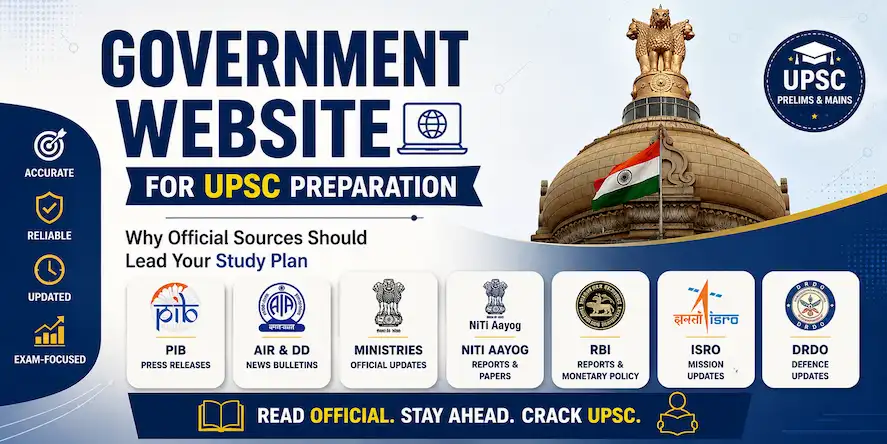
Accessing an authenticated government website for UPSC preparation [August 24, 2026] ensures aspirants receive verified data on agricultural price support architectures, mineral reforms, and national commemorative events without commercial distortion.

Topic 01 • Indian Agriculture & Price Stabilization

PM-AASHA: Structural Components of Farmer Remuneration & Buffer Stocking

  • Price Support Scheme (PSS): Physical procurement of pulses, oilseeds, and copra at Minimum Support Price (MSP) by central nodal agencies (NAFED, FCI) when wholesale market prices dip below MSP during peak harvest.
  • Price Deficiency Payment Scheme (PDPS): Direct cash transfer into farmers' verified Aadhaar-linked bank accounts covering the difference between MSP and the actual modal market sale price, eliminating physical storage costs.
  • Price Stabilization Fund (PSF): Strategic procurement and maintenance of buffer stocks for sensitive horticultural essentials (pulses, onions, and potatoes) to tame consumer inflation.
  • Market Intervention Scheme (MIS): Implemented on state request for perishable agricultural and horticultural crops not covered under mandatory MSP frameworks.
🔍 Prelims Extra Value Additions (Static & Dynamic Linkages)
  • Institutional Governance: Launched in 2018 under the Ministry of Agriculture & Farmers Welfare, integrating pre-existing procurement mechanisms into a unified umbrella scheme.
  • PDPS Inspiration: Modeled on Madhya Pradesh's pioneering Bhavantar Bhugtan Yojana.
  • CACP Mandate: MSP is recommended by the Commission for Agricultural Costs and Prices (CACP) based on the A2+FL and C2 cost formulas for 22 mandated crops plus Fair and Remunerative Price (FRP) for sugarcane.
🎯 UPSC CSE 2020 / CAPF AC Question 1 of 7

Under the 'Price Deficiency Payment Scheme' (PDPS) component of PM-AASHA, how is price support extended to registered agricultural producers?

✅ Correct Answer: B
Explanation: PDPS involves zero physical procurement of produce; instead, the price gap between the MSP and the registered market sale price is directly credited to the farmer's bank account.
Topic 02 • Sustainable Agriculture & Organic Standards

PGS-India Natural Certification: FPO-Led Agro-Ecological Transition

Agricultural circulars compiled on the government website for UPSC preparation [August 24, 2026] detail how community-based certification empowers Farmer Producer Organizations (FPOs) in Madhya Pradesh and Uttar Pradesh to market chemical-free produce.

  • PGS-India Natural Framework: A locally focused, peer-review quality assurance certification ensuring agricultural produce is 100% natural, chemical-free, and grown with bio-inputs.
  • On-Farm Formulations: Relies on traditional fermented bio-inputs including Agniastra (pest management), Beejamrit (microbial seed treatment), and Jeevamrit (soil microbiology booster).
  • FPO Aggregation: Implemented through clusters like Maa Annpuneshwari FPO (Dewas, MP - Maize) and Gao Mata Natural Fed FPO (Gorakhpur, UP - Wheat) to bridge the farm-to-consumer value chain.
🔍 Prelims Extra Value Additions (Static & Dynamic Linkages)
  • PGS vs Third-Party Certification: PGS-India is cost-effective, farmer-led, and operated under the National Project on Organic Farming (NPOF), whereas APEDA manages third-party commercial export certification (NPOP).
  • National Mission on Natural Farming (NMNF): A dedicated central scheme promoting Bhartiya Prakritik Krishi Paddhati (BPKP) across riverine belts and tribal districts.
🎯 UPSC CSE 2018 / TNPSC Group 1 Question 2 of 7

With reference to the Participatory Guarantee System for India (PGS-India), consider the following statements:
1. It is a process of certifying organic/natural products that involves active participation of producers and consumers.
2. It is implemented under the aegis of the Ministry of Agriculture and Farmers Welfare.
Which of the statements given above is/are correct?

✅ Correct Answer: C (Both 1 and 2)
Explanation: PGS-India is a peer-review certification program operationalized under the Department of Agriculture & Farmers Welfare to facilitate accessible organic validation for smallholders.
Topic 03 • Governance, Welfare Schemes & Agritech

PM-KISAN Platform: Direct Income Support & Digital Verification Systems

  • Direct Benefit Transfer (DBT): Delivers an assured supplemental income of ₹6,000 per annum in three equal four-monthly installments of ₹2,000 to eligible landholding farmer families.
  • Digital Service Stack: Features self-service online registration, Aadhaar-seeded land record authentication, automated payment status verification, and online grievance redressal.
  • Universal Scope: Expanded from small and marginal farmers (SMFs) to encompass all cultivable landholding farmer households, subject to exclusion criteria (e.g., institutional landholders, income tax payees).
🔍 Prelims Extra Value Additions (Static & Dynamic Linkages)
  • Fiscal Categorization: A Central Sector Scheme with 100% funding from the Government of India.
  • Technological Convergence: Integrated with AgriStack, dynamic digital land registries, and AI chatbots (Kisan e-Mitra) for multilingual service access.
🎯 SSC CGL 2023 / UPPSC Question 3 of 7

Under the Pradhan Mantri Kisan Samman Nidhi (PM-KISAN), what is the total annual financial benefit transferred directly to eligible farmer families?

✅ Correct Answer: A (₹6,000 in three equal installments)
Explanation: PM-KISAN credits ₹2,000 every four months directly into verified bank accounts of eligible landholder families nationwide.
Topic 04 • Economic Policy, Mining & Strategic Minerals

Mines and Minerals (Development and Regulation) Amendment: Strategic Mineral Security

Mineral policy notifications released through the government website for UPSC preparation [August 24, 2026] outline structural reforms to unlock domestic exploration of critical metals and reduce import vulnerabilities.

  • Tax & Royalty Rationalization: Establishes a predictable, stable tax framework to spur domestic mining exploration and balance state revenue with national strategic interests.
  • Critical Minerals Thrust: Facilitates private sector participation in the commercial exploration and auction of critical and strategic minerals (Lithium, Cobalt, Nickel, Platinum Group Elements, Rare Earth Elements).
  • Import Substitution: Directly aimed at securing raw material independence for clean energy transitions, electric vehicle manufacturing, advanced defense electronics, and aerospace applications.
🔍 Prelims Extra Value Additions (Static & Dynamic Linkages)
  • Statutory Evolution: Principal legislation is the MMDR Act, 1957. Earlier pivotal amendments in 2015 introduced mandatory electronic auctions via the National Mineral Exploration Trust (NMET) and District Mineral Foundations (DMFs).
  • Exploration Licence (EL): Introduced in recent reforms to allow junior exploration companies to undertake reconnaissance and prospecting for deep-seated critical minerals.
🎯 UPSC CSE 2023 / CDS Pattern Question 4 of 7

Which of the following minerals are officially categorized as 'Critical and Strategic Minerals' crucial for India's clean energy transition and high-tech manufacturing?
1. Lithium
2. Cobalt
3. Nickel
4. Rare Earth Elements
Select the correct answer using the code given below:

✅ Correct Answer: D (1, 2, 3 and 4)
Explanation: All listed elements—Lithium, Cobalt, Nickel, and REEs—are part of India's identified 24 critical minerals vital for national energy security and industrial resilience.
Topic 05 • Modern Indian History & Revolutionary Movement

Revolutionary Legacy: Shivaram Hari Rajguru & The Lahore Conspiracy Case

  • Biographical Roots: Born on 24 August 1908 in Khed (renamed Rajgurunagar in his honor), Pune District, Maharashtra.
  • Revolutionary Cadre: Prominent member of the Hindustan Socialist Republican Association (HSRA), working closely with Chandrasekhar Azad, Bhagat Singh, and Sukhdev Thapar.
  • Saunders Assassination (1928): Along with Bhagat Singh, executed the assassination of British police officer J.P. Saunders in Lahore to avenge the brutal death of veteran leader Lala Lajpat Rai following the anti-Simon Commission lathi-charge.
  • Martyrdom: Hanged by the colonial government on 23 March 1931 at Lahore Central Jail alongside Bhagat Singh and Sukhdev (commemorated annually as Shaheed Diwas).
🔍 Prelims Extra Value Additions (Static & Dynamic Linkages)
  • HRA to HSRA: Founded originally as the Hindustan Republican Association (HRA) in 1924 in Kanpur by Ram Prasad Bismil, Sachindra Nath Sanyal, and Jogesh Chandra Chatterjee; reorganized as HSRA in September 1928 at Feroz Shah Kotla, Delhi, adopting a socialist vision.
  • Hussainiwala Memorial: The cremation site of the trio on the banks of the Sutlej River in Firozpur, Punjab.
🎯 UPSC CSE 2019 / CAPF AC Question 5 of 7

The historic Lahore Conspiracy Case of 1929, which led to the trial and execution of Bhagat Singh, Rajguru, and Sukhdev, was initiated in connection with:

✅ Correct Answer: B
Explanation: The second Lahore Conspiracy Case tried HSRA leaders for the killing of British police official J.P. Saunders, culminating in the execution of the three revolutionaries on March 23, 1931.
Topic 06 • Science & Technology, Space Exploration

National Space Day: Celebrating Chandrayaan-3 Lunar South Pole Feat

Science and technology archives featured on the government website for UPSC preparation [August 24, 2026] commemorate India's lunar landing achievements and subsequent interplanetary roadmap.

  • Commemoration Date: Celebrated on August 23 every year to honor the soft landing of Chandrayaan-3's Vikram Lander on the lunar surface in 2023.
  • Historic Milestone: Made India the first nation in the world to achieve a soft landing near the lunar South Polar region, and the 4th country globally to land on the Moon.
  • Landing Point Nomenclature: The landing touchdown site of Vikram Lander was officially named 'Shiv Shakti Point', while Chandrayaan-2's impact site was designated 'Tiranga Point'.
🔍 Prelims Extra Value Additions (Static & Dynamic Linkages)
  • Scientific Payloads:
    • Pragyan Rover: APXS (Alpha Particle X-ray Spectrometer) and LIBS (Laser Induced Breakdown Spectroscopy) for elemental composition.
    • Vikram Lander: ChaSTE (thermal properties), ILSA (lunar seismicity), and RAMBHA-LP (plasma density).
  • National Space Day 2024–2026 Themes: Focuses on space entrepreneurship, IN-SPACe integration, and the upcoming Gaganyaan human spaceflight mission.
🎯 UPSC CDS / NDA 2024 Question 6 of 7

Why is August 23 designated as 'National Space Day' in India?

✅ Correct Answer: C
Explanation: The Government of India notified August 23 as National Space Day to commemorate the historic soft-landing of the Chandrayaan-3 Vikram lander on August 23, 2023.
Topic 07 • Performing Arts & Indian Classical Heritage

Ustad Bismillah Khan: Elevating Shehnai from Folk Ritual to Concert Stage

  • Cultural Epicentre: Born in Dumraon, Bihar (1916), but his musical devotion and life remained inseparable from Varanasi (Banaras), where he played regularly at the Kashi Vishwanath Temple and along the Ganga ghats.
  • Artistic Contribution: Single-handedly transformed the Shehnai from an auspicious folk/wedding instrument (Naubat) into a revered classical concert instrument.
  • National Milestone: Had the rare distinction of performing live from the ramparts of the Red Fort on India's first Independence Day, 15th August 1947.
  • Highest Recognition: Conferred India's highest civilian honor, the Bharat Ratna, in 2001.
🔍 Prelims Extra Value Additions (Static & Dynamic Linkages)
  • Instrument Classification (Natya Shastra): Shehnai belongs to the Sushira Vadya (aerophone / wind instruments) family, alongside the flute and nagaswaram.
  • Hindustani Tradition: Associated with the Benaras Gharana, known for its rich integration of Thumri, Kajri, and Chaiti folk melodies into classical ragas.
🎯 SSC CGL / State PSC Culture Question 7 of 7

Despite not being his birthplace, which ancient cultural city is inextricably tied to the life, sadhana, and music of Bharat Ratna Ustad Bismillah Khan?

✅ Correct Answer: C (Varanasi)
Explanation: Ustad Bismillah Khan spent his entire life in Varanasi, drawing spiritual and musical inspiration from the Ganga and Kashi Vishwanath temple.

Frequently Asked Questions

1. What is the fundamental difference between PSS and PDPS under PM-AASHA?
PSS involves physical crop procurement at MSP, whereas PDPS pays the price deficiency directly into farmer bank accounts without physical handling.
2. How does PGS-India certification differ from APEDA's NPOP system?
PGS-India is a peer-review system tailored for domestic smallholders, while NPOP is a third-party commercial certification focused on international exports.
3. Why are critical minerals highlighted in the MMDR Amendment Act?
Critical minerals like Lithium and Cobalt are vital for electric vehicles, renewable storage, and defense, requiring accelerated domestic exploration.
4. What is the historical significance of August 23 in India's space calendar?
August 23 marks National Space Day, commemorating the successful landing of Chandrayaan-3 near the Moon's South Pole at Shiv Shakti Point.
5. Which instrument category does the classical Shehnai represent?
Under ancient Natya Shastra classification, the Shehnai is categorized as a Sushira Vadya (wind/aerophone instrument).

Consistently revising authenticated daily releases from the government website for UPSC preparation [August 24, 2026] bridges the gap between static textbook foundations and evolving dynamic policies.

Source Data: Press Information Bureau (PIB), Ministry of Agriculture, Ministry of Mines, and Ministry of Culture.

© 2026 Aspirants Hub. Daily Examination Intelligence.

🚀 Join Our Exam Preparation Community

Stay ahead in your preparation with daily exam-focused content, curated for UPSC, TNPSC, SSC and other competitive exams.

📲 Telegram Community
👉 5,000+ active aspirants
👉 50+ MCQs reflected in recent exams (2024 & 2025)
👉 Daily quizzes, PYQs & revision content
👉 Positive feedback from prelims-cleared candidates

Join Telegram

▶️ YouTube Channel
👉 Daily Current Affairs videos
👉 Based on The Hindu, PIB, Government sources
👉 PYQ-focused explanation (UPSC, TNPSC)
👉 Short, exam-oriented analysis

Subscribe Now

📸 Instagram Updates
👉 Daily quick revision posts
👉 Exam facts & current affairs snippets

Follow on Instagram

💼 LinkedIn
👉 Professional updates & exam insights

Connect on LinkedIn

+Trusted by thousands of aspirants preparing for competitive exams

government website for UPSC preparation

Government Website for UPSC Preparation – 07 July 2026

Government Website for UPSC Preparation brings you official UPSC Current Affairs Notes prepared directly from PIB releases, ministry notifications and verified government websites. Every topic is presented in an exam-oriented format covering Why in News, What is It, Key Highlights, Importance, Prelims Facts and UPSC MCQs to help aspirants prepare efficiently for both UPSC Prelims and Mains.

Topics Covered

This page includes topic-wise current affairs from official government sources published on 07 July 2026. Every update is verified before publication and organized for quick revision.

Why Use Government Website for UPSC Preparation?

  • 100% Official Government Sources
  • PIB & Ministry Updates
  • Prelims and Mains Focused Notes
  • Why in News & Key Highlights
  • Important Facts for Revision
  • UPSC MCQs with Explanation
  • Daily Updated Current Affairs

Who Can Benefit?

These notes are useful for UPSC Civil Services Examination (CSE), TNPSC, SSC, Banking, Railway, Defence, CAPF and other competitive examinations.

Frequently Asked Questions (FAQs)

What is Government Website for UPSC Preparation?

It is a collection of UPSC Current Affairs Notes prepared directly from official government websites, PIB releases and ministry updates.

Are these notes useful for UPSC Prelims and Mains?

Yes. Every topic includes Prelims facts, Mains points, important highlights and exam-oriented explanations.

Which official sources are used?

Sources include PIB, Government Ministries, NITI Aayog, RBI, ISRO, DRDO and other verified government websites.

How often are these notes updated?

Government Website for UPSC Preparation is updated daily with the latest official government current affairs.

Scroll to Top