
Government Updates for UPSC Preparation – 29 July 2026 Current Affairs Notes
1. International Tiger Day 2026 – India Home to Over 70% of World's Wild Tigers
🔹 Why in News?
- International Tiger Day is observed on 29 July every year to raise awareness about tiger conservation.
- India highlighted that it is home to over 70% of the world's wild tigers.
🔹 What is it?
- International Tiger Day, also known as Global Tiger Day, was established at the Saint Petersburg Tiger Summit, 2010.
- Its aim is to promote the protection and expansion of wild tiger habitats.
🔹 Key Highlights
- India's tiger population rose from 1,411 in 2006 to 3,682 in 2022 (as per the All India Tiger Estimation).
- India has 58 Tiger Reserves covering approximately ~85,000 sq. km.
- 23 tiger reserves are accredited under CA|TS (Conservation Assured | Tiger Standards) as of December 2023.
- National Tiger Conservation Authority (NTCA) plays a pivotal role through habitat protection, scientific monitoring and community-based conservation.
- Project Tiger was launched in 1973 and is India's flagship tiger conservation programme.
🔹 Why Important?
- Relevant for GS-III: Environment and Ecology, Biodiversity Conservation.
- Important for Prelims facts on Project Tiger, NTCA, tiger reserves and tiger population data.
🔹 UPSC Prelims Facts
| Fact | Details |
|---|---|
| International Tiger Day | 29 July every year |
| Project Tiger Launch | 1973 |
| Tiger Population (2022) | 3,682 |
| Tiger Population (2006) | 1,411 |
| Tiger Reserves in India | 58 |
| Area under Tiger Reserves | ~85,000 sq. km (in 2026) |
| CA|TS Accredited Reserves | 23 (as of December 2023) |
| Nodal Authority | NTCA (National Tiger Conservation Authority) |
🔹 Practice MCQ
Q. As per the latest All India Tiger Estimation, India's tiger population in 2022 was:
A) 1,411
B) 2,226
C) 3,682
D) 4,500
Click to View Answer
Answer: C — India's tiger population rose to 3,682 in 2022 from 1,411 in 2006, reflecting the success of Project Tiger and NTCA's conservation efforts. India is home to over 70% of the world's wild tigers.
2. Parliament Pulse – Monsoon Session, 28 July 2026
🔹 Why in News?
- Key legislative and statistical updates were shared in the Monsoon Session of Parliament (28 July 2026).
🔹 What is it?
- A compilation of bills moved and written replies tabled in Parliament covering economy, governance and welfare.
🔹 Key Highlights
- Public Examinations (Prevention of Unfair Means) (Amendment) Bill, 2026 moved in Lok Sabha — to amend the 2024 Act and further strengthen measures against paper leaks, organised examination fraud and unfair practices.
- GNPA of Public Sector Banks (PSBs): At a historic low of 1.9% in FY 2025–26.
- PM Surya Ghar: Muft Bijli Yojana: Over 48 lakh+ households benefitted since its launch in February 2024.
- Jan Aushadhi Kendras: 20,149 opened across the country as on June 30, 2026.
- India's Exports: Scaled a record US$ 863.1 billion in FY 2025–26.
- CFCFRMS (I4C): Financial amount of ₹11,158 crore+ saved across 32.8 lakh+ complaints till June 30, 2026.
🔹 Why Important?
- Relevant for GS-II: Governance, Parliament and GS-III: Economy, Cyber Security.
🔹 UPSC Prelims Facts
| Fact | Details |
|---|---|
| PSB GNPA (FY 2025-26) | 1.9% (historic low) |
| PM Surya Ghar Launch | February 2024; 48 lakh+ households benefitted |
| Jan Aushadhi Kendras | 20,149 (as on June 30, 2026) |
| India's Exports FY 2025-26 | US$ 863.1 billion (record) |
| CFCFRMS Amount Saved | ₹11,158 crore+ (32.8 lakh+ complaints) |
🔹 Practice MCQ
Q. The Gross Non-Performing Assets (GNPA) of Public Sector Banks reached which historic low in FY 2025-26?
A) 3.5%
B) 2.5%
C) 1.9%
D) 0.9%
Click to View Answer
Answer: C — GNPA of Public Sector Banks reached a historic low of 1.9% in FY 2025-26, as shared in Parliament's written replies on 28 July 2026.
3. CWG 2026 Update – India Tally Reaches 10 Medals including 2 Golds
🔹 Why in News?
- India added 5 more medals at the Commonwealth Games 2026, Glasgow, taking the total tally to 10 medals including 2 Golds.
🔹 Key Highlights – New Medals Won
| Athlete | Event | Medal | Note |
|---|---|---|---|
| Sharmila Dhankar | Women's Shot Put F57 (Para Athletics) | 🥇 Gold | India's first-ever CWG Para Athletics gold |
| Sarvesh Kushare | Men's High Jump | 🥈 Silver | First Indian to win CWG silver in Men's High Jump |
| Bindyarani Devi | Women's 58kg Weightlifting | 🥉 Bronze | Her 2nd Commonwealth Games medal |
| Valluri Ajaya Babu | Men's 79kg Weightlifting | 🥈 Silver | Set CWG Snatch Record (330kg total) |
🔹 Why Important?
- Important for Sports Current Affairs and Prelims facts on Indian medal winners at CWG 2026.
🔹 Practice MCQ
Q. Sharmila Dhankar created history at CWG 2026 by winning India's first-ever CWG gold in:
A) Women's Weightlifting
B) Para Powerlifting
C) Women's Shot Put F57 (Para Athletics)
D) Women's Boxing
Click to View Answer
Answer: C — Sharmila Dhankar won gold in Women's Shot Put F57 (Para Athletics) at CWG 2026, Glasgow, creating history with India's first-ever CWG Para Athletics gold medal.
4. PM SHRI Schools – 13,092 Schools Selected; Big Education Push
🔹 Why in News?
- MoS Education Jayant Chaudhary informed Lok Sabha about the status of PM SHRI Schools across India.
🔹 What is it?
- PM SHRI = PM Schools for Rising India.
- A Centrally Sponsored Scheme to strengthen school education and create modern, quality, inclusive and future-ready learning environments.
- Schools have been selected across States, UTs, including KVS, NVS and NCERT institutions.
🔹 Key Highlights
- 13,092 schools selected under PM SHRI scheme.
- Scheme aims to strengthen more than 14,500 schools across India.
- Top States by PM SHRI schools selected: Uttar Pradesh (1,888), Andhra Pradesh (982), Maharashtra (946), Madhya Pradesh (944), Bihar (904), Telangana (832), Odisha (840), Rajasthan (749), Karnataka (660).
- PM SHRI also supports non-Hindi language teachers: Sanskrit (6,102), Urdu (1,994), Regional languages (9,152) teachers deployed.
- States like AP, Telangana, Karnataka, Punjab, Odisha show significant regional-language teacher deployment.
🔹 Why Important?
- Relevant for GS-II: Education Policy, NEP 2020.
- Useful for Prelims facts on school education schemes.
🔹 UPSC Prelims Facts
| Fact | Details |
|---|---|
| Scheme Name | PM SHRI (PM Schools for Rising India) |
| Type | Centrally Sponsored Scheme |
| Schools Selected | 13,092 |
| Target Schools | 14,500+ |
| Top State | Uttar Pradesh (1,888 schools) |
| Informed By | MoS Education Jayant Chaudhary in Lok Sabha |
🔹 Practice MCQ
Q. PM SHRI stands for:
A) PM Scheme for Human Resource Investment
B) PM Schools for Rising India
C) PM Scheme for Holistic Rural Improvement
D) PM Schools for Rural and Hill India
Click to View Answer
Answer: B — PM SHRI stands for PM Schools for Rising India. It is a Centrally Sponsored Scheme with 13,092 schools selected, aiming to create quality, modern and inclusive learning environments across India.
5. India Achieves E20 Ethanol Blending Target – Looks Beyond E20
🔹 Why in News?
- India achieved its 20% ethanol blending target in petrol (E20) during Ethanol Supply Year (ESY) 2025–26, five years ahead of the original 2030 goal.
🔹 What is it?
- Ethanol blending refers to mixing ethanol (produced from sugarcane, maize, broken rice, surplus foodgrains etc.) with petrol to reduce fossil fuel import dependence and carbon emissions.
- E20 means petrol blended with 20% ethanol.
🔹 Key Highlights
- Ethanol blending rose sharply from 1.53% in 2013–14 to 20% in 2025–26 — a massive jump in a decade.
- Target achieved 5 years ahead of the original 2030 deadline.
- Key policy measures that helped: Administered pricing, expanded feedstock options, long-term offtake agreements, better storage infrastructure.
- Ethanol feedstocks approved: Sugarcane-based materials, maize, damaged foodgrains, broken rice, surplus foodgrains.
- Food security and PDS requirements remain the top priority; only surplus foodgrains can be used for ethanol.
- Government also promoting 2G ethanol (second-generation) from agricultural residues.
- Current ethanol production capacity: ~2,000 crore litres/year.
- Roadmap includes E20, higher ethanol blends, and flex-fuel vehicles.
🔹 Why Important?
- Relevant for GS-III: Energy, Environment, Agriculture.
- Key for Prelims facts on ethanol blending programme, E20, biofuels policy.
🔹 UPSC Prelims Facts
| Fact | Details |
|---|---|
| E20 Target Achieved | ESY 2025–26 (5 years ahead of 2030 goal) |
| Blending in 2013–14 | 1.53% |
| Blending in 2025–26 | 20% |
| Ethanol Production Capacity | ~2,000 crore litres/year |
| 2G Ethanol | From agricultural residues |
🔹 Practice MCQ
Q. India's ethanol blending in petrol rose from 1.53% in 2013-14 to 20% in 2025-26. This E20 target was achieved how many years ahead of the original deadline?
A) 2 years
B) 3 years
C) 5 years
D) 7 years
Click to View Answer
Answer: C — India achieved its 20% ethanol blending target in petrol during ESY 2025-26, which is 5 years ahead of the original 2030 deadline. Blending rose from just 1.53% in 2013-14 to 20% in a decade.
6. SVEP – Start-Up Village Entrepreneurship Programme Driving Rural Entrepreneurship
🔹 Why in News?
- The government highlighted the achievements of the Start-Up Village Entrepreneurship Programme (SVEP) in empowering rural communities through non-farm businesses.
🔹 What is it?
- SVEP: Launched in 2016 under DAY-NRLM (Deendayal Antyodaya Yojana – National Rural Livelihoods Mission).
- Helps SHGs (Self-Help Groups) and rural families establish non-farm businesses.
- Provides training, mentoring, financial support and access to credit.
🔹 Key Highlights
- Over 4.32 lakh rural enterprises supported.
- Around 86% of entrepreneurs belong to SC, ST, OBC and minority communities.
- At least 60% beneficiaries are women.
- ₹942 crore released by the Centre for implementation.
- A government evaluation found that 99% of SVEP-supported enterprises are profitable.
- Community mentors trained to help rural entrepreneurs access finance, markets, and business guidance.
🔹 Why Important?
- Relevant for GS-II: Government Policies, Social Justice and GS-III: Rural Economy, Livelihoods.
🔹 UPSC Prelims Facts
| Fact | Details |
|---|---|
| Full Name | Start-Up Village Entrepreneurship Programme |
| Launched | 2016 under DAY-NRLM |
| Rural Enterprises Supported | 4.32 lakh+ |
| Women Beneficiaries | At least 60% |
| SC/ST/OBC/Minority Share | ~86% of entrepreneurs |
| Centre Fund Released | ₹942 crore |
| Profitability | 99% SVEP enterprises profitable |
🔹 Practice MCQ
Q. The Start-Up Village Entrepreneurship Programme (SVEP) was launched in 2016 under which national mission?
A) PM Kisan Yojana
B) DAY-NRLM
C) MGNREGS
D) PM Mudra Yojana
Click to View Answer
Answer: B — SVEP was launched in 2016 under DAY-NRLM (Deendayal Antyodaya Yojana – National Rural Livelihoods Mission). It has supported over 4.32 lakh rural enterprises, with 60% women beneficiaries and 99% profitability rate.
7. Kargil Vijay Diwas 2026 – 27th Anniversary of Operation Vijay
🔹 Why in News?
- India observed Kargil Vijay Diwas on 26 July 2026, marking the 27th anniversary of India's victory in the Kargil War of 1999.
🔹 What is it?
- Kargil Vijay Diwas commemorates the success of Operation Vijay, in which the Indian Armed Forces recaptured strategic heights in the Kargil district of Jammu & Kashmir from Pakistani intruders.
🔹 Key Highlights
- In May 1999, Pakistani intruders occupied strategic heights in Kargil.
- Indian Armed Forces launched Operation Vijay (Army) supported by Operation Safed Sagar (Indian Air Force) to recapture territory.
- Key battles at: Tololing, Tiger Hill, Batalik and Point 4875 turned the tide.
- On 26 July 1999, India declared victory after reclaiming all occupied positions without crossing the Line of Control (LoC).
- India honoured its heroes with: 4 Param Vir Chakras, 9 Maha Vir Chakras, 55 Vir Chakras.
🔹 Why Important?
- Relevant for GS-III: Internal Security, Defence and GS-I: Modern India.
- Useful for Prelims facts on Kargil War, gallantry awards, Indian military operations.
🔹 UPSC Prelims Facts
| Fact | Details |
|---|---|
| Kargil Vijay Diwas | 26 July every year |
| Operation Vijay | Indian Army's operation to recapture Kargil heights (1999) |
| IAF Operation | Operation Safed Sagar |
| Key Battles | Tololing, Tiger Hill, Batalik, Point 4875 |
| Victory Declared | 26 July 1999 |
| Param Vir Chakras Awarded | 4 |
| Maha Vir Chakras | 9 |
| Vir Chakras | 55 |
🔹 Practice MCQ
Q. The Indian Air Force's air operation during the Kargil War 1999 was codenamed:
A) Operation Meghdoot
B) Operation Vijay
C) Operation Safed Sagar
D) Operation Parakram
Click to View Answer
Answer: C — The Indian Air Force's air operation during the Kargil War 1999 was codenamed Operation Safed Sagar. The Indian Army's ground operation was Operation Vijay. India declared victory on 26 July 1999.
✦ End of Notes – 29 July 2026 ✦
📚 Hindu Editorial Analysis Today
🎥 UPSC & TNPSC Video - Pdf Resources
🚀 Join Our Exam Preparation Community
Stay ahead in your preparation with daily exam-focused content, curated for UPSC, TNPSC, SSC and other competitive exams.
📲 Telegram Community
👉 5,000+ active aspirants
👉 50+ MCQs reflected in recent exams (2024 & 2025)
👉 Daily quizzes, PYQs & revision content
👉 Positive feedback from prelims-cleared candidates
▶️ YouTube Channel
👉 Daily Current Affairs videos
👉 Based on The Hindu, PIB, Government sources
👉 PYQ-focused explanation (UPSC, TNPSC)
👉 Short, exam-oriented analysis
📸 Instagram Updates
👉 Daily quick revision posts
👉 Exam facts & current affairs snippets
💼 LinkedIn
👉 Professional updates & exam insights
+Trusted by thousands of aspirants preparing for competitive exams
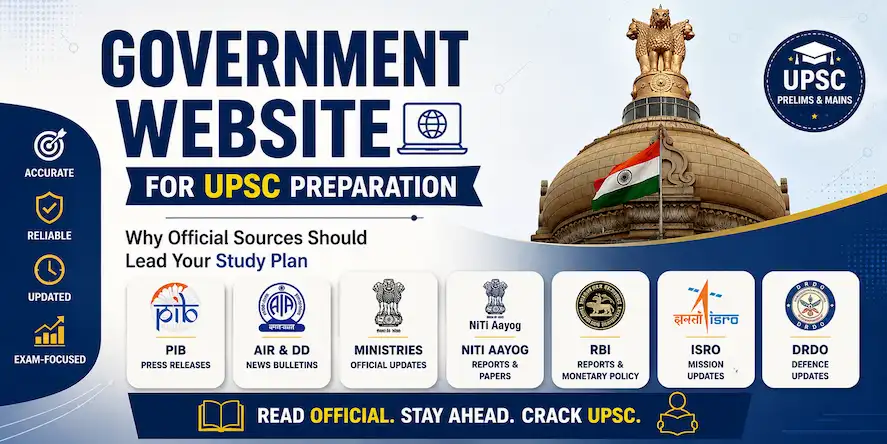
Government Website for UPSC Preparation – 07 July 2026
Government Website for UPSC Preparation brings you official UPSC Current Affairs Notes prepared directly from PIB releases, ministry notifications and verified government websites. Every topic is presented in an exam-oriented format covering Why in News, What is It, Key Highlights, Importance, Prelims Facts and UPSC MCQs to help aspirants prepare efficiently for both UPSC Prelims and Mains.
Topics Covered
This page includes topic-wise current affairs from official government sources published on 07 July 2026. Every update is verified before publication and organized for quick revision.
Why Use Government Website for UPSC Preparation?
- 100% Official Government Sources
- PIB & Ministry Updates
- Prelims and Mains Focused Notes
- Why in News & Key Highlights
- Important Facts for Revision
- UPSC MCQs with Explanation
- Daily Updated Current Affairs
Who Can Benefit?
These notes are useful for UPSC Civil Services Examination (CSE), TNPSC, SSC, Banking, Railway, Defence, CAPF and other competitive examinations.
Frequently Asked Questions (FAQs)
What is Government Website for UPSC Preparation?
It is a collection of UPSC Current Affairs Notes prepared directly from official government websites, PIB releases and ministry updates.
Are these notes useful for UPSC Prelims and Mains?
Yes. Every topic includes Prelims facts, Mains points, important highlights and exam-oriented explanations.
Which official sources are used?
Sources include PIB, Government Ministries, NITI Aayog, RBI, ISRO, DRDO and other verified government websites.
How often are these notes updated?
Government Website for UPSC Preparation is updated daily with the latest official government current affairs.