
Government Website for UPSC Preparation [August 26, 2026]
Consulting an official government website for UPSC preparation [August 26, 2026] provides civil services aspirants with vetted data on river-linking projects, unorganized labour social security frameworks, revolutionary history, and drug regulatory directives.
Karni-Bharni Folios: Visual Ledgers of Jain Ethics & Karmic Cosmology
- Philosophical Nature: Karni-Bharni folios are rare illustrated Jain manuscripts serving as graphic visual ledger books depicting Jain ethical codes, karmic causation, and cosmological retribution.
- Artistic Architecture: Each painted narrative panel is framed above and below with descriptive textual commentary detailing specific transgressive earthly deeds (bad karma) and their corresponding retaliatory punishments in subterranean hellish realms (Narak).
- Chronology & Geography: 18th- and 19th-century didactic folk-art masterpieces originating in Western India, primarily across Gujarat and Rajasthan.
- Preservation: Curated and preserved at the National Museum, New Delhi.
- Jain Karma Doctrine: Karma is considered subtle physical matter (Pudgala) adhering to the soul (Jiva).
- Western Indian School: Characterized by projecting eyes, angular draughtsmanship, and mineral pigments.
With reference to the cultural heritage of India, the 18th–19th century 'Karni-Bharni' folios preserved at the National Museum represent which tradition?
Explanation: The Karni-Bharni folios from Western India are didactic Jain manuscripts serving as pictorial ledgers of moral deeds and their cosmic retributive consequences.
Major Durga Malla: The First Indian Gorkha Martyr of the Azad Hind Fauj
Historical documentation accessible through the government website for UPSC preparation [August 26, 2026] commemorates the valor of INA officers who mounted armed resistance along the North-Eastern frontiers.
- Biographical Origins: Born on 1 July 1913 in Doiwala near Dehradun to a Khas Thakuri/Chetri Gorkha family; inspired by Mahatma Gandhi's 1930 Dandi March.
- Military Trajectory: Joined the 2/1 Gorkha Rifles in 1931; transitioned to the Indian National Army (INA) under Netaji Subhas Chandra Bose in 1942 as Major.
- Espionage & Capture: Captured by British intelligence on 27 March 1944 while gathering covert reconnaissance data near Kohima.
- Martyrdom: Tried at Red Fort and executed on 25 August 1944 (commemorated annually as Balidan Diwas).
- INA Formation: Conceived first by Captain Mohan Singh (1942) and later reorganized by Netaji Subhas Chandra Bose in 1943.
- Red Fort Trials (1945–46): Defense led by Bhulabhai Desai, Tej Bahadur Sapru, and Jawaharlal Nehru.
Who among the following was the first Indian Gorkha officer of the Indian National Army (Azad Hind Fauj) to be executed by the British at the Red Fort for wartime reconnaissance?
Explanation: Major Durga Malla of the INA intelligence branch was captured near Kohima and executed on 25 August 1944.
Bina Das: The Fearless Revolutionary of Bengal's Chhatri Sangha
- Convocation Attack (1932): In February 1932, graduate Bina Das fired five shots at the Governor of Bengal, Sir Stanley Jackson, during the Calcutta University convocation.
- Revolutionary Network: Active member of the semi-revolutionary women's student group Chhatri Sangha and associated with Jugantar.
- Quit India Movement: Following imprisonment, joined the Congress, actively organized underground actions in 1942, and was later honored with the Padma Shri in 1960.
- Contemporary Women Revolutionaries: Kalpana Datta, Pritilata Waddedar, Santi Ghosh, and Suniti Chaudhary.
- Autobiography: Authored her powerful Bengali memoir Shrinkhal Jhankar ('Chains of Resonance').
During the Civil Disobedience era in Bengal, which woman revolutionary attempted to assassinate Bengal Governor Stanley Jackson at the Calcutta University convocation?
Explanation: Bina Das fired at Governor Stanley Jackson on 6 February 1932 in the Senate Hall of Calcutta University.
Ken-Betwa Link Project: River Interlinking Architecture & Bundelkhand Matrix
Hydrological project reports published on the government website for UPSC preparation [August 26, 2026] highlight the engineering layout and ecological balances governing the nation's premier river-linking initiative.
- Project Profile: ₹44,605-crore flagship project transferring surplus water from the Ken river (MP) to the water-deficit Betwa river (UP).
- Key Infrastructure: 96.7-metre-high Daudhan Dam on the Ken river and a 216.5-km link canal carrying water to Barua Sagar near Jhansi.
- Benefits: Irrigates 10.62 lakh hectares, supplies drinking water to ~62 lakh people, generates 103 MW hydro and 27 MW solar power.
- River System: Both Ken and Betwa are major right-bank tributaries of the Yamuna River.
- Ecological Aspect: Submerges part of the Core Habitat of Panna Tiger Reserve (PTR) in MP.
With reference to the Ken-Betwa Link Project, consider the following:
1. Both are tributaries of Yamuna.
2. Daudhan dam is on Betwa.
3. Panna Tiger Reserve falls in submergence zone.
Which are correct?
Explanation: Daudhan Dam is constructed on the Ken River (not Betwa). Statements 1 and 3 are correct.
Unified Payments Interface: Exponential Scale & Cross-Border Integration
- Transaction Surge: Transaction value expanded 4500X from ₹0.07 lakh crore (FY17) to ₹314 lakh crore (FY26), with over 2,360+ crore monthly transactions.
- Merchant Network: Acceptance endpoints grew 261X from 0.31 crore to over 81+ crore endpoints in 2026.
- Global Presence: Operational across 11 international jurisdictions including UAE, France, Singapore, Mauritius, Sri Lanka, Nepal, and Maldives.
- Developer: National Payments Corporation of India (NPCI), a Section 8 non-profit created under PSS Act, 2007.
- International Arm: Cross-border deployments managed by NPCI International Payments Limited (NIPL).
Which body developed the Unified Payments Interface (UPI) platform enabling real-time digital inter-bank payments?
Explanation: NPCI developed UPI on top of the IMPS platform.
e-Shram Portal at 5 Years: National Unorganized Worker Registry
Labour governance datasets hosted on the government website for UPSC preparation [August 26, 2026] track social security coverage for gig workers, platform aggregators, and migrant labourers.
- National Database: Launched on 26 August 2021 as the National Database of Unorganized Workers (NDUW), seeded with Aadhaar.
- Demographics: Over 31.89 crore workers registered (Women: 54.28%, Men: 45.72%; 55.21% aged 18–40 years).
- Coverage: Integrates gig workers, domestic workers, street vendors, and migrant labourers with 15 welfare schemes.
- Universal Account Number: Assigns a portable 12-digit permanent e-Shram UAN.
- Code on Social Security (2020): Statutorily defines gig and platform workers.
The 'e-Shram Portal' launched by the Ministry of Labour and Employment is designed to:
Explanation: e-Shram is a centralized Aadhaar-linked database to deliver social security to informal workers.
Fixed-Dose Combinations: Safety Restrictions on Pediatric Cold Formulations
- Pediatric Ban: CDSCO restricted Chlorpheniramine Maleate + Phenylephrine FDC for children under 4 years.
- Warning Label: Mandates prominent box warnings stating "Do not use in children below four years of age".
- Regulatory Body: Evaluated and banned under Section 26A of Drugs & Cosmetics Act, 1940 based on DTAB recommendations.
- FDC Definition: Product containing two or more active pharmaceutical ingredients (APIs) in a fixed ratio.
- DTAB: Highest statutory technical advisory body under Drugs & Cosmetics Act, 1940.
Which statutory body advises Central and State Governments on technical matters under the Drugs and Cosmetics Act, 1940?
Explanation: DTAB is the apex statutory technical committee constituted under Section 5 of the Drugs and Cosmetics Act, 1940.
Frequently Asked Questions
1. What is the key geographic objective of the Ken-Betwa Link Project?
It transfers surplus monsoon runoff from the Ken river basin (MP) to the drought-prone Betwa basin (UP) across Bundelkhand.
2. What are the historical Karni-Bharni folios?
They are 18th-19th century didactic Jain illustrated manuscripts from Western India that visually depict ethical karma and afterlife cosmology.
3. Why is 25th August commemorated as Balidan Diwas?
It marks the martyrdom of Major Durga Malla, the first Indian Gorkha officer of the INA executed by the British at the Red Fort in 1944.
4. How does the e-Shram portal benefit unorganized and gig workers?
It registers workers under a permanent 12-digit UAN to facilitate unified delivery of social security, pension, and insurance schemes.
5. Under which law are irrational Fixed-Dose Combinations (FDCs) prohibited in India?
FDCs are regulated and banned under Section 26A of the Drugs and Cosmetics Act, 1940 based on DTAB recommendations.
Consistently integrating daily briefings from the government website for UPSC preparation [August 26, 2026] bridges the gap between static syllabus chapters and current policy interventions.
© 2026 Aspirants Hub. Daily Examination Intelligence.
📚 Hindu Editorial Analysis Today
🎥 UPSC & TNPSC Video - Pdf Resources
🚀 Join Our Exam Preparation Community
Stay ahead in your preparation with daily exam-focused content, curated for UPSC, TNPSC, SSC and other competitive exams.
📲 Telegram Community
👉 5,000+ active aspirants
👉 50+ MCQs reflected in recent exams (2024 & 2025)
👉 Daily quizzes, PYQs & revision content
👉 Positive feedback from prelims-cleared candidates
▶️ YouTube Channel
👉 Daily Current Affairs videos
👉 Based on The Hindu, PIB, Government sources
👉 PYQ-focused explanation (UPSC, TNPSC)
👉 Short, exam-oriented analysis
📸 Instagram Updates
👉 Daily quick revision posts
👉 Exam facts & current affairs snippets
💼 LinkedIn
👉 Professional updates & exam insights
+Trusted by thousands of aspirants preparing for competitive exams
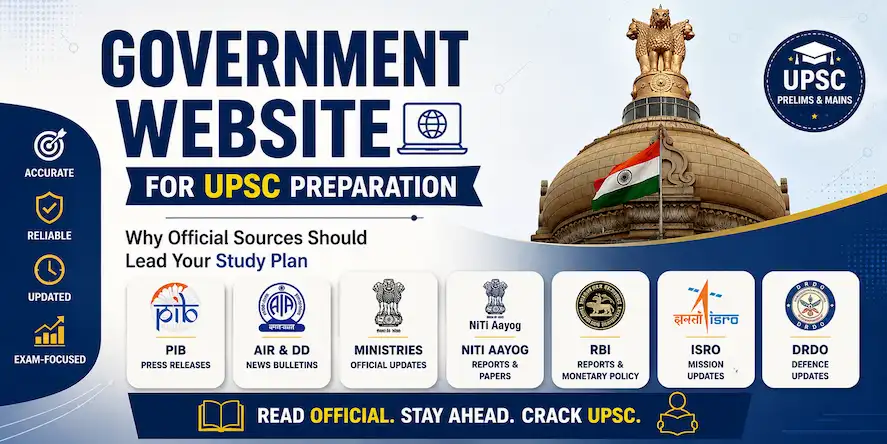
Government Website for UPSC Preparation – 07 July 2026
Government Website for UPSC Preparation brings you official UPSC Current Affairs Notes prepared directly from PIB releases, ministry notifications and verified government websites. Every topic is presented in an exam-oriented format covering Why in News, What is It, Key Highlights, Importance, Prelims Facts and UPSC MCQs to help aspirants prepare efficiently for both UPSC Prelims and Mains.
Topics Covered
This page includes topic-wise current affairs from official government sources published on 07 July 2026. Every update is verified before publication and organized for quick revision.
Why Use Government Website for UPSC Preparation?
- 100% Official Government Sources
- PIB & Ministry Updates
- Prelims and Mains Focused Notes
- Why in News & Key Highlights
- Important Facts for Revision
- UPSC MCQs with Explanation
- Daily Updated Current Affairs
Who Can Benefit?
These notes are useful for UPSC Civil Services Examination (CSE), TNPSC, SSC, Banking, Railway, Defence, CAPF and other competitive examinations.
Frequently Asked Questions (FAQs)
What is Government Website for UPSC Preparation?
It is a collection of UPSC Current Affairs Notes prepared directly from official government websites, PIB releases and ministry updates.
Are these notes useful for UPSC Prelims and Mains?
Yes. Every topic includes Prelims facts, Mains points, important highlights and exam-oriented explanations.
Which official sources are used?
Sources include PIB, Government Ministries, NITI Aayog, RBI, ISRO, DRDO and other verified government websites.
How often are these notes updated?
Government Website for UPSC Preparation is updated daily with the latest official government current affairs.