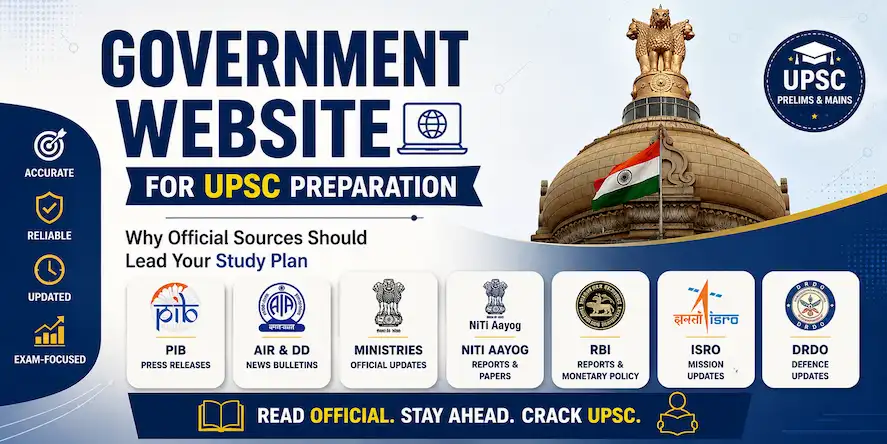
Government Website for UPSC Preparation [August 26, 2026]
UPSC CSEPIB & Ministry Verified
Government Website for UPSC Preparation [August 26, 2026]
📅 ⏱️ 10 Min Read🎯 Multi-Exam PYQ Tagged
Consulting an official government website for UPSC preparation [August 26, 2026] provides civil services aspirants with vetted data on river-linking projects, unorganized labour social security frameworks, revolutionary history, and drug regulatory directives.
Topic 01 • Ancient & Medieval Indian Art, Culture & Philosophy
Karni-Bharni Folios: Visual Ledgers of Jain Ethics & Karmic Cosmology
Philosophical Nature:Karni-Bharni folios are rare illustrated Jain manuscripts serving as graphic visual ledger books depicting Jain ethical codes, karmic causation, and cosmological retribution.
Artistic Architecture: Each painted narrative panel is framed above and below with descriptive textual commentary detailing specific transgressive earthly deeds (bad karma) and their corresponding retaliatory punishments in subterranean hellish realms (Narak).
Chronology & Geography: 18th- and 19th-century didactic folk-art masterpieces originating in Western India, primarily across Gujarat and Rajasthan.
Preservation: Curated and preserved at the National Museum, New Delhi.
🔍 Prelims Extra Value Additions (Static & Dynamic Linkages)
Jain Karma Doctrine: Karma in Jainism is considered subtle physical matter (Pudgala) that clings to the soul (Jiva), divided into destructive (Ghatiya) and non-destructive (Aghatiya) karmas.
Western Indian Painting School: Also known as the Gujarati/Jain School, characterized by exaggerated eyes extending beyond facial profiles, angular draughtsmanship, and brilliant mineral pigments (e.g., illustrated Kalpasutra and Kalgakacharyakatha).
🎯 UPSC CSE 2014 / State PSCQuestion 1 of 7
With reference to the cultural heritage of India, the 18th–19th century 'Karni-Bharni' folios preserved at the National Museum represent which of the following traditions?
✅ Correct Answer: B Explanation: The Karni-Bharni folios from Western India (Gujarat/Rajasthan) are didactic Jain manuscripts serving as pictorial ledgers of moral deeds and their cosmic retributive consequences.
Topic 02 • Modern Indian History & Revolutionary Nationalism
Major Durga Malla: The First Indian Gorkha Martyr of the Azad Hind Fauj
Historical documentation accessible through the government website for UPSC preparation [August 26, 2026] commemorates the valor of INA officers who mounted armed resistance along the North-Eastern frontiers.
Biographical Origins: Born on 1 July 1913 in Doiwala near Dehradun to a Khas Thakuri/Chetri Gorkha family; inspired by Mahatma Gandhi's 1930 Dandi March during his school years.
Military Trajectory: Joined the 2/1 Gorkha Rifles in 1931 at age 18; later transitioned to the Indian National Army (INA) under Netaji Subhas Chandra Bose in 1942, rising to the rank of Major.
Espionage & Capture: Captured by British intelligence on 27 March 1944 while gathering covert reconnaissance data near Kohima on the Assam-Burma front.
Martyrdom: Tried at the Red Fort, New Delhi, and executed on 25 August 1944 (commemorated annually as Balidan Diwas by the Gorkha community globally).
🔍 Prelims Extra Value Additions (Static & Dynamic Linkages)
INA Formation Milestones: Conceived first by Captain Mohan Singh in Malaya (1942) with Japanese Major Iwaichi Fujiwara, reorganized under Rash Behari Bose, and subsequently energized by Netaji Subhas Chandra Bose in Singapore (July 1943).
Historic Red Fort Trials (1945–46): Defense of INA soldiers (Prem Sahgal, Gurbaksh Singh Dhillon, Shahnawaz Khan) led by Bhulabhai Desai, Tej Bahadur Sapru, and Jawaharlal Nehru.
🎯 UPSC CAPF AC / CDSQuestion 2 of 7
Who among the following was the first Indian Gorkha officer of the Indian National Army (Azad Hind Fauj) to be executed by the British at the Red Fort for wartime reconnaissance missions?
✅ Correct Answer: C (Major Durga Malla) Explanation: Major Durga Malla of the INA intelligence branch was captured near Kohima and hanged at the Delhi Central Jail/Red Fort on 25 August 1944.
Topic 03 • Women in Indian Freedom Struggle
Bina Das: The Fearless Revolutionary of Bengal's Chhatri Sangha
Convocation Attack (1932): In February 1932, young graduate Bina Das fired five shots point-blank at the Governor of Bengal, Sir Stanley Jackson, during the convocation ceremony of the University of Calcutta.
Revolutionary Network: Active member of the semi-revolutionary women's student group Chhatri Sangha and associated with the Jugantar group in Bengal.
Mainstream Transition: Following imprisonment, joined the Indian National Congress, actively mobilized underground actions during the Quit India Movement (1942), and later served in the West Bengal Legislative Assembly.
Civilian Honor: Awarded the Padma Shri in 1960 for lifelong humanitarian and social service.
🔍 Prelims Extra Value Additions (Static & Dynamic Linkages)
Contemporary Women Revolutionaries in Bengal: Kalpana Datta and Pritilata Waddedar (associated with Surya Sen in the 1930 Chittagong Armoury Raid); Santi Ghosh and Suniti Chaudhary (shot dead Magistrate C.G.B. Stevens in Comilla, 1931).
Autobiography: Authored her powerful Bengali memoir Shrinkhal Jhankar ('Chains of Resonance').
🎯 UPSC CSE 2021 / State PSCQuestion 3 of 7
During the Civil Disobedience era in Bengal, which woman revolutionary attempted to assassinate Bengal Governor Stanley Jackson while receiving her degree at the Calcutta University convocation?
✅ Correct Answer: A (Bina Das) Explanation: Bina Das fired at Governor Stanley Jackson on 6 February 1932 in the Senate Hall of Calcutta University as an act of resistance against colonial oppression.
Topic 04 • Infrastructure, Water Resources & Bundelkhand Geography
Ken-Betwa Link Project: River Interlinking Architecture & Irrigation Matrix
Hydrological project reports published on the government website for UPSC preparation [August 26, 2026] highlight the engineering layout and ecological balances governing the nation's premier river-linking initiative.
Project Profile: A ₹44,605-crore flagship initiative under the National Perspective Plan, transferring surplus water from the Ken river in Madhya Pradesh to the water-deficit Betwa river in Uttar Pradesh.
Key Infrastructure: Features a massive 96.7-metre-high Daudhan Dam on the Ken river (in Panna and Chhatarpur districts, MP) and a 216.5-km Ken–Betwa Link Canal terminating at Barua Sagar near Jhansi.
Secondary Components: Integrates the Lower Orr Project, Kotha Barrage, Bina Complex Multipurpose Project, and modern piped micro-irrigation networks.
Socio-Economic Deliverables: Provides annual irrigation to 10.62 lakh hectares, drinking water to ~62 lakh people across drought-prone Bundelkhand, 103 MW of hydropower, and 27 MW of solar power.
🔍 Prelims Extra Value Additions (Static & Dynamic Linkages)
River Drainage: Both Ken and Betwa are major right-bank tributaries of the Yamuna River originating in the Vindhyan Range.
Ecological Impact: Partial submergence of the Core Habitat of the Panna Tiger Reserve (PTR) in Madhya Pradesh, compensated by adding Nauradehi and Durgavati sanctuaries into the Greater Panna Landscape.
Implementing Body: Executed through the Special Purpose Vehicle (SPV) named Ken-Betwa Link Project Authority (KBLPA).
🎯 UPSC CSE 2022 / UPPSCQuestion 4 of 7
With reference to the Ken-Betwa River Interlinking Project, consider the following statements:
1. Both Ken and Betwa rivers are tributaries of the Yamuna River.
2. The Daudhan Dam is constructed on the Betwa river to transfer water to the Ken basin.
3. A part of the Panna Tiger Reserve falls in the submergence zone of the project.
Which of the statements given above are correct?
✅ Correct Answer: C (1 and 3 only) Explanation: Statement 2 is incorrect because the Daudhan Dam is constructed on the Ken River to transfer surplus water to the Betwa River basin. Statements 1 and 3 are correct.
Topic 05 • Indian Economy, Digital Public Infrastructure & FinTech
Transaction Surge: Value of transactions expanded by 4500X from ₹0.07 lakh crore in FY 2016-17 to ₹314 lakh crore in FY 2025-26, logging over 2,360+ crore monthly transactions.
Merchant Acceptance Network: QR-based merchant payment acceptance points grew 261X from 0.31 crore in 2018 to over 81+ crore endpoints in 2026.
Cross-Border Linkages: UPI is actively operational across 11 international jurisdictions including UAE (Jaywan/NIPL), Singapore (PayNow-UPI link), France, Mauritius, Sri Lanka, Bhutan, Nepal, and Maldives.
🔍 Prelims Extra Value Additions (Static & Dynamic Linkages)
Developer & Regulatory Authority: Developed by the National Payments Corporation of India (NPCI), an umbrella entity established under the Payment and Settlement Systems Act, 2007 (promoted by RBI and IBA as a Section 8 non-profit).
International Subsidiary: Cross-border deployments are executed through NPCI International Payments Limited (NIPL).
🎯 UPSC CSE 2017 PYQQuestion 5 of 7
Which of the following bodies developed the Unified Payments Interface (UPI) platform that enables real-time inter-bank digital transactions in India?
✅ Correct Answer: B (NPCI) Explanation: [UPSC CSE 2017 Direct Question] NPCI built UPI on top of the Immediate Payment Service (IMPS) infrastructure.
Topic 06 • Social Justice, Labour Welfare & Digital Governance
e-Shram Portal at 5 Years: National Unorganized Worker Registry
Labour governance datasets hosted on the government website for UPSC preparation [August 26, 2026] track social security coverage for gig workers, platform aggregators, and migrant labourers.
National Database Creation: Launched on 26 August 2021 by the Ministry of Labour & Employment as India's first comprehensive National Database of Unorganized Workers (NDUW), seeded with Aadhaar.
e-Shram One-Stop Solution: Upgraded to unify 15 central and state social security schemes on a single interoperable platform, integrating PM-SYM pension, accidental life insurance, and National Career Service (NCS).
Registration Demographics: Over 31.89 crore workers registered, with women comprising 54.28% and men 45.72%; prime working age demographic (18–40 years) represents 55.21% of the database.
Inclusion Mandate: Formally registers domestic workers, agricultural labourers, construction workers, street vendors, and gig/platform economy workers.
🔍 Prelims Extra Value Additions (Static & Dynamic Linkages)
Universal Account Number (UAN): Registered workers receive a 12-digit permanent e-Shram UAN valid nationwide.
Code on Social Security, 2020: Statutorily defines 'gig worker', 'platform worker', and 'unorganized worker' for extending welfare funds.
🎯 UPSC EPFO EO/AO / SSC CGLQuestion 6 of 7
The 'e-Shram Portal', launched by the Ministry of Labour and Employment, is primarily designed to:
✅ Correct Answer: D Explanation: e-Shram creates an Aadhaar-linked centralized database of unorganized and gig workers to streamline targeted delivery of social welfare benefits.
Topic 07 • Public Health, Pharmacology & Drug Regulation
Fixed-Dose Combinations: Safety Restrictions on Pediatric Cold Formulations
Pediatric Ban: The Central Drugs Standard Control Organisation (CDSCO) restricted the fixed-dose combination (FDC) of Chlorpheniramine Maleate + Phenylephrine for children under 4 years of age.
Mandatory Packaging Warning: Manufacturers are directed to mandatorily print prominent black-box warnings stating "Do not use in children below four years of age" across package inserts, labels, and promotional brochures.
Regulatory Rationale: Formulations pose clinical risks of cardiac arrhythmia, respiratory distress, and central nervous excitation in infants, especially given safer monotherapy alternatives.
Statutory Body: The action follows technical assessments by an Expert Panel and the Drugs Technical Advisory Board (DTAB) under Section 26A of the Drugs and Cosmetics Act, 1940.
🔍 Prelims Extra Value Additions (Static & Dynamic Linkages)
What is an FDC? A product containing two or more active pharmaceutical ingredients (APIs) combined in a fixed dosage ratio in a single dosage form.
Apex Drug Advisory Body: DTAB is the highest statutory technical advisory body constituted under the Drugs and Cosmetics Act, 1940 to advise the Central and State Governments on drug safety.
🎯 UPSC CSE 2019 / State PSCQuestion 7 of 7
In India, which statutory body advises the Central Government and State Governments on technical matters arising out of the administration of the Drugs and Cosmetics Act, 1940?
✅ Correct Answer: A (Drugs Technical Advisory Board) Explanation: DTAB is the statutory technical body constituted under Section 5 of the Drugs and Cosmetics Act, 1940 to advise governments on drug safety, efficacy, and FDC prohibitions.
Frequently Asked Questions
1. What is the key geographic objective of the Ken-Betwa Link Project?
It transfers surplus monsoon runoff from the Ken river basin (MP) to the drought-prone Betwa basin (UP) across Bundelkhand.
2. What are the historical Karni-Bharni folios?
They are 18th-19th century didactic Jain illustrated manuscripts from Western India that visually depict ethical karma and afterlife cosmology.
3. Why is 25th August commemorated as Balidan Diwas?
It marks the martyrdom of Major Durga Malla, the first Indian Gorkha officer of the INA executed by the British at the Red Fort in 1944.
4. How does the e-Shram portal benefit unorganized and gig workers?
It registers workers under a permanent 12-digit UAN to facilitate unified delivery of social security, pension, and insurance schemes.
5. Under which law are irrational Fixed-Dose Combinations (FDCs) prohibited in India?
FDCs are regulated and banned under Section 26A of the Drugs and Cosmetics Act, 1940 based on DTAB recommendations.
Consistently integrating daily briefings from the government website for UPSC preparation [August 26, 2026] bridges the gap between static syllabus chapters and current policy interventions.
▶️ YouTube Channel 👉 Daily Current Affairs videos 👉 Based on The Hindu, PIB, Government sources 👉 PYQ-focused explanation (UPSC, TNPSC) 👉 Short, exam-oriented analysis