
Government Website for UPSC Preparation [August 28, 2026]
Consulting an official government website for UPSC preparation [August 28, 2026] provides civil services aspirants with vetted academic briefings on Mahabodhi architecture, financial inclusion milestones, Swadeshi literary heritage, and transboundary disaster dynamics.
Firaq Gorakhpuri: The Civil Services Aspirant Who Embraced Non-Cooperation & Urdu Poetry
- Patriotic Defiance: Born as Raghupati Sahay in Gorakhpur, UP; despite being selected for the prestigious Provincial Civil Service (PCS/ICS cadre), he resigned his bureaucratic post to join Mahatma Gandhi's Non-Cooperation Movement (1920) and endured colonial imprisonment.
- Literary Renaissance: Served as Professor of English Literature at Allahabad University while revolutionizing 20th-century Urdu Ghazals and Nazms, synthesizing classical Persian imagery with Indian folk ethos.
- Historic Accolades: Conferred the Jnanpith Award in 1969 for his magnum opus Gul-e-Naghma (the first Urdu poet to receive India's highest literary honour), the Sahitya Akademi Award (1960), and the Padma Bhushan (1968).
- Non-Cooperation Movement (1920–22): Authorized at the Nagpur Congress Session (Dec 1920); involved surrender of government titles, resignation from nominated civil posts, and boycott of foreign goods.
- Jnanpith Award Details: Established in 1961 by Bharatiya Jnanpith; open to Indian citizens writing in languages listed in the 8th Schedule of the Constitution plus English.
Which renowned Urdu poet and nationalist leader resigned from his selection in the Civil Services to participate in Mahatma Gandhi's Non-Cooperation Movement in 1920?
Explanation: Raghupati Sahay (Firaq Gorakhpuri) gave up his civil service appointment during Gandhi's call for non-cooperation and later became the first Urdu author to win the Jnanpith Award.
Mahabodhi Temple Complex: Classical Brick Architecture & The Seven Sacred Sites
Archaeological and cultural documentation on the government website for UPSC preparation [August 28, 2026] highlights the architectural evolution of Bodh Gaya as one of India's earliest surviving brick monuments.
- Architectural Benchmark: The Mahabodhi Temple in Bodh Gaya, Bihar, represents one of the earliest and most imposing surviving brick structural temples in India, dating to the late Gupta period (5th–6th century CE).
- Sacred Geography: Commemorates the holy spot where Siddhartha Gautama attained supreme Enlightenment (Bodhi) under the sacred Bodhi Tree (Ficus religiosa).
- The Seven Sacred Weeks (Saptasattaha): Incorporates six adjacent holy shrines including the Vajrasana (Diamond Throne built by Ashoka), Animeshlochan Chaitya, Ratnachakrama (Jewel Walk), and Muchalinda Lake.
- UNESCO Status: Inscribed as a UNESCO World Heritage Site in 2002 as the spiritual epicenter of global Buddhism.
- Vajrasana (Diamond Throne): Polished sandstone slab installed by Emperor Ashoka in the 3rd century BCE marking the exact meditation seat of Buddha.
- Niranjana River: Situated along the banks of the ancient Phalgu (Niranjana) River in Gaya, Bihar.
With reference to ancient Indian temple architecture, the Mahabodhi Temple at Bodh Gaya is particularly notable for being constructed predominantly using:
Explanation: The grand central shikhara of the Mahabodhi Temple is one of the oldest monumental brick structures surviving from classical India.
"Ekla Cholo Re": Rabindranath Tagore's Call for Atmashakti in the Anti-Partition Movement
- Historical Genesis: Composed in 1905 by Rabindranath Tagore amid widespread popular defiance against the Partition of Bengal orchestrated by Viceroy Lord Curzon.
- Original Publication: Originally titled "Eka", the song was first published in the September 1905 issue of the nationalist monthly Bhandar.
- Ideological Core (Atmashakti): Embodied Tagore's philosophy of moral courage and self-reliance—exhorting patriots to uphold justice and truth even when left completely unassisted.
- Nationalist Anthem Matrix: Along with Amar Sonar Bangla and Vande Mataram, it became the rallying cry of Swadeshi volunteer corps during Raksha Bandhan unity protests in 1905.
- Partition of Bengal Proclamation: Announced in July 1905 and enforced on 16 October 1905; revoked in 1911 by Lord Hardinge at the Delhi Durbar.
- Swadeshi Constructive Programme: Establishment of National Schools (National Council of Education under Aurobindo Ghosh) and Swadeshi chemical factories (P.C. Ray's Bengal Chemicals).
In the context of the Swadeshi Movement (1905), the iconic song 'Ekla Cholo Re' (originally titled 'Eka') was composed by Rabindranath Tagore to promote which core nationalist ideal?
Explanation: Tagore composed 'Ekla Cholo Re' in 1905 as a psychological call for self-reliance and standing firm for truth regardless of collective abandonment.
PM Jan Dhan Yojana: Elimination of the Financial Inclusion Gender Gap (2014–2024)
Financial inclusion benchmarks published on the government website for UPSC preparation [August 28, 2026] demonstrate how targeted accounts erased gender disparity in household financial ownership.
- Closing the Gender Gap: Women's formal bank account ownership expanded dramatically from 43% in 2014 to 89% in 2024, virtually closing the historical divide with men (62% in 2014 to 88% in 2024).
- Women Account Base: Over 33 Crore women have opened individual operative accounts under the Pradhan Mantri Jan Dhan Yojana (PMJDY), providing financial autonomy.
- Grassroots Delivery (Bank Sakhis): Deployed over 50,000+ Bank Sakhis (Women Business Correspondents from Self-Help Groups under DAY-NRLM) to provide doorstep banking, micro-credit, and pension payouts in remote villages.
- JAM Trinity Architecture: Jan Dhan, Aadhaar, and Mobile connectivity enable leak-proof Direct Benefit Transfer (DBT) under 300+ welfare schemes.
- Account Features: Zero-balance Basic Savings Bank Deposit (BSBD) account, free RuPay debit card with ₹2 lakh inbuilt accident insurance, and ₹10,000 overdraft facility.
Which of the following is/are the key features of the Pradhan Mantri Jan Dhan Yojana (PMJDY)?
1. Zero minimum balance requirement.
2. Accidental insurance cover linked to RuPay debit cards.
3. Overdraft facility up to ₹10,000 for eligible account holders.
Select the correct answer using the code below:
Explanation: PMJDY offers zero-balance accounts, RuPay accidental insurance cover, and an overdraft facility up to ₹10,000 per eligible household.
PMFME Scheme: Commercial Scaling of Grassroots Agro-Enterprises & ODOP
- Grassroots Enterprise Transformation: The PMFME Scheme (PM Formalisation of Micro food processing Enterprises) supports unorganized micro-units with capital credit subsidies, technical modern machinery, and quality branding.
- State Value-Addition Case Studies:
• Bihar: Value-added processed Makhana cookies, roasted trail mixes, and export snacks.
• Rajasthan: Tribal SHGs commercializing Jamun vinegar and indigenous forest fruit preserves.
• Maharashtra: Non-GMO high-protein flavored tofu and soya derivatives.
• Odisha: Climate-resilient millet value products entering international export corridors. - Market Linkages: Integrates rural Self-Help Groups (SHGs) and Farmer Producer Organizations (FPOs) directly into national e-commerce channels (Amazon, Flipkart, ONDC).
- Nodal Ministry & Outlay: Centrally sponsored scheme under the Ministry of Food Processing Industries (MoFPI) with ₹10,000 crore outlay under Atmanirbhar Bharat.
- One District One Product (ODOP): Adopts the ODOP approach to reap benefit of scale in procurement of inputs, common services, and product marketing.
Under the PM Formalisation of Micro food processing Enterprises (PMFME) Scheme, which strategic approach is adopted to build competitive scale in input procurement and marketing?
Explanation: PMFME leverages the One District One Product (ODOP) model to concentrate raw material supply, common processing infrastructure, and collective branding.
Trans-Himalayan Hazards: Glacier Collapse, GLOF Dynamics & Riparian Impact
Disaster management bulletins accessible through the government website for UPSC preparation [August 28, 2026] analyze the geological triggers behind sudden debris flows across Himalayan river valleys.
- Trigger Mechanism: Structural collapse of the lower snout of a high-altitude Himalayan glacier (instigated by seismic instability and warming permafrost) crashed into the valley floor.
- Cascade Flow: High-energy mixture of ice, pulverized moraine, and rocks dammed and surged down the Lhende Khola River, generating destructive flash floods along the Nepal-Tibet border.
- Strategic Damage: Struck Gyirong Port (a vital international trade transit corridor between Tibet, China and Nepal), destroying hydropower stations, highway bridges, and riparian habitations.
- Transboundary Riparian Impact: Prompted high flood alerts and preventive evacuations across downstream North Bihar districts fed by transboundary tributaries.
- GLOF vs Glacial Avalanche: Glacial Lake Outburst Floods (GLOFs) occur when moraine or ice dams containing glacial lakes breach, while glacial avalanches involve ice-rock slope failure.
- Third Pole Vulnerability: The Hindu Kush Himalayan (HKH) region is warming at nearly double the global average rate, accelerating glacial retreat and formation of unstable proglacial lakes.
In the context of Himalayan geography, sudden high-magnitude flash floods and debris flows in trans-Himalayan rivers are most frequently triggered by:
Explanation: Himalayan flash floods are caused by cryospheric instability, including glacier collapse, landslide dam outburst floods (LDOFs), and glacial lake breaches.
Frequently Asked Questions
1. Why is the Mahabodhi Temple considered an architectural milestone?
It is one of the earliest monumental brick structures surviving in India, originating in the late Gupta period.
2. What is the historical context behind the song 'Ekla Cholo Re'?
Composed by Rabindranath Tagore in 1905 during the anti-Partition Swadeshi agitation to inspire moral courage and self-reliance.
3. How did PMJDY transform women's financial inclusion in India?
It doubled women's bank account ownership from 43% (2014) to 89% (2024), fully bridging the historical gender gap.
4. What is the primary objective of the PMFME Scheme?
It formalizes and scales micro food enterprises through credit capital subsidies, technical upgrades, and the ODOP framework.
5. What causes severe transboundary floods along the Nepal-Tibet border?
Sudden glacier collapses, moraine failure, and GLOFs in high-altitude trans-Himalayan valleys surging into river courses.
Consistently integrating daily briefings from the government website for UPSC preparation [August 28, 2026] bridges the gap between static syllabus chapters and current policy interventions.
© 2026 Aspirants Hub. Daily Examination Intelligence.
📚 Hindu Editorial Analysis Today
🎥 UPSC & TNPSC Video - Pdf Resources
🚀 Join Our Exam Preparation Community
Stay ahead in your preparation with daily exam-focused content, curated for UPSC, TNPSC, SSC and other competitive exams.
📲 Telegram Community
👉 5,000+ active aspirants
👉 50+ MCQs reflected in recent exams (2024 & 2025)
👉 Daily quizzes, PYQs & revision content
👉 Positive feedback from prelims-cleared candidates
▶️ YouTube Channel
👉 Daily Current Affairs videos
👉 Based on The Hindu, PIB, Government sources
👉 PYQ-focused explanation (UPSC, TNPSC)
👉 Short, exam-oriented analysis
📸 Instagram Updates
👉 Daily quick revision posts
👉 Exam facts & current affairs snippets
💼 LinkedIn
👉 Professional updates & exam insights
+Trusted by thousands of aspirants preparing for competitive exams
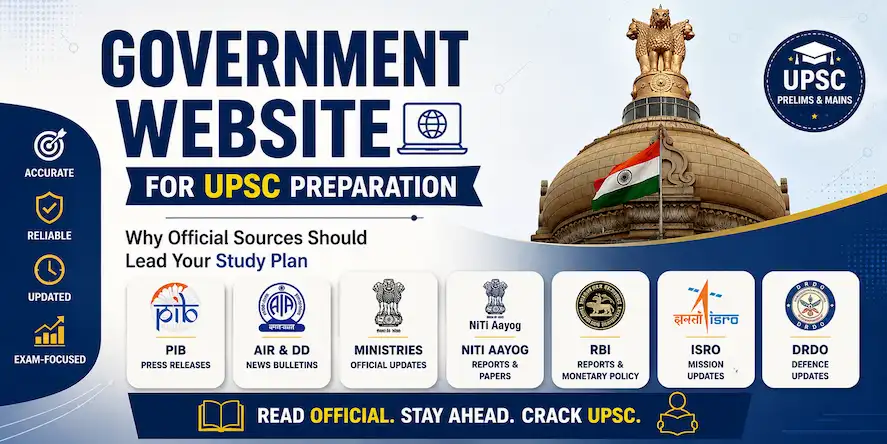
Government Website for UPSC Preparation – 07 July 2026
Government Website for UPSC Preparation brings you official UPSC Current Affairs Notes prepared directly from PIB releases, ministry notifications and verified government websites. Every topic is presented in an exam-oriented format covering Why in News, What is It, Key Highlights, Importance, Prelims Facts and UPSC MCQs to help aspirants prepare efficiently for both UPSC Prelims and Mains.
Topics Covered
This page includes topic-wise current affairs from official government sources published on 07 July 2026. Every update is verified before publication and organized for quick revision.
Why Use Government Website for UPSC Preparation?
- 100% Official Government Sources
- PIB & Ministry Updates
- Prelims and Mains Focused Notes
- Why in News & Key Highlights
- Important Facts for Revision
- UPSC MCQs with Explanation
- Daily Updated Current Affairs
Who Can Benefit?
These notes are useful for UPSC Civil Services Examination (CSE), TNPSC, SSC, Banking, Railway, Defence, CAPF and other competitive examinations.
Frequently Asked Questions (FAQs)
What is Government Website for UPSC Preparation?
It is a collection of UPSC Current Affairs Notes prepared directly from official government websites, PIB releases and ministry updates.
Are these notes useful for UPSC Prelims and Mains?
Yes. Every topic includes Prelims facts, Mains points, important highlights and exam-oriented explanations.
Which official sources are used?
Sources include PIB, Government Ministries, NITI Aayog, RBI, ISRO, DRDO and other verified government websites.
How often are these notes updated?
Government Website for UPSC Preparation is updated daily with the latest official government current affairs.