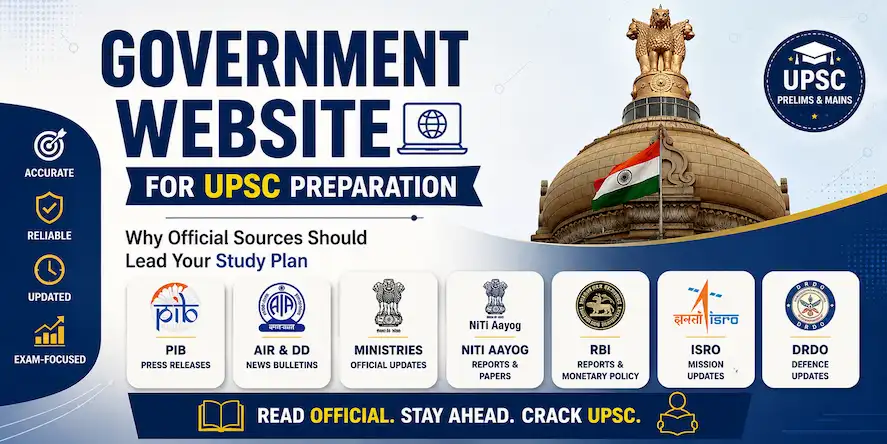
Government Website for UPSC Preparation September 21
Consulting an official Government Website for UPSC Preparation September 21 provides civil services aspirants with vetted academic briefings on PMAY-Urban 2.0 housing frameworks, SBM-Gramin ODF Plus benchmarks, wetland ecology in Tamil Nadu and Maharashtra, digital payments architecture, and ozone layer protection milestones.
PMAY-Urban 2.0: Structural Expansion, Middle-Class Inclusivity & Women Titling
Urban governance updates released through the Government Website for UPSC Preparation September 21 highlight the structural expansion of affordable housing credit and mandatory female ownership.
- PMAY-U 2.0 Launch: Extends financial assistance to address the housing requirements of 1 crore additional urban poor and middle-class families through interest subsidies and affordable rental housing.
- Cumulative Sanctions: Over 1.25 crore houses sanctioned under the mission umbrella since inception.
- Gender Empowerment Benchmark: Over 1 crore houses have been mandatorily allotted in the name of the female head of the household or under joint ownership, securing immovable property rights for women.
- Four Verticals: Beneficiary-Led Construction (BLC), Affordable Housing in Partnership (AHP), In-Situ Slum Redevelopment (ISSR), and Credit Linked Subsidy Scheme (CLSS).
- Nodal Ministry: Ministry of Housing and Urban Affairs (MoHUA).
- Mandatory Female Ownership Clause: A unique statutory requirement under PMAY-U to ensure houses constructed with central assistance are registered in the name of female members or jointly.
With reference to the Pradhan Mantri Awas Yojana - Urban (PMAY-U), which of the following is a mandatory condition for ownership of houses constructed under the scheme for EWS/LIG categories?
Explanation: PMAY-U mandates that houses sanctioned under EWS/LIG categories must be registered in the name of the female head of the household or in joint ownership with the male head to ensure gender empowerment.
Swachhata Hi Seva 2026: Youth-Centric Sanitation & Experiential Learning
- Campaign Duration: Observed as an annual nationwide mass mobilization from 17th September to 2nd October 2026 (culminating on Swachh Bharat Diwas / Gandhi Jayanti).
- Core Focus (Students & Youth): Envisages schools and colleges as foundational spaces for instilling cleanliness as a lifelong institutional value (Sanskaar).
- Key Activities:
• Swachhata Gyan Yatras: Educational exposure visits of students to functional Material Recovery Facilities (MRFs), waste-to-energy plants, and plastic waste processing units.
• Swachhata Evam Jal Sanchay Samvads: Community dialogues linking sanitation with rainwater harvesting and graywater management.
• SWM Rules 2026 Literacy: Experiential learning on mandatory four-way source segregation.
- Nodal Joint Coordination: Executed jointly by the Department of Drinking Water and Sanitation (Ministry of Jal Shakti) and Ministry of Housing and Urban Affairs (MoHUA).
- Jan Andolan Metric: Focuses on collective Shramdaan (voluntary community labour) to eliminate Black Spots / Cleanliness Target Units (CTUs).
The annual 'Swachhata Hi Seva' (SHS) campaign organized across India serves as a precursor to which national observance on 2nd October?
Explanation: The fortnight-long Swachhata Hi Seva campaign (17 Sept – 2 Oct) culminates on 2nd October, celebrated as Swachh Bharat Diwas to commemorate Mahatma Gandhi's birth anniversary.
Swachh Bharat Mission (Gramin) Phase-II: 89.5% ODF Plus Model Village Coverage
- ODF Plus Model Coverage: Out of 5.86 lakh+ total villages reported on the SBM(G) Integrated Management Information System (IMIS), over 5.25 lakh villages (89.5%) are verified as ODF Plus (Model).
- Liquid Waste Management (LWM): 5.65 lakh villages (96.4%) have established institutional arrangements for graywater management (soak pits, community leach pits, and waste stabilization ponds).
- Solid Waste Management (SWM): 5.38 lakh villages (91.8%) have functional door-to-door collection, community compost pits, and plastic waste management units.
- Faecal Sludge Infrastructure: Constructed 217 dedicated Rural Faecal Sludge Treatment Plants (FSTPs) alongside urban-rural co-treatment linkages.
- ODF Plus Criteria: An ODF village that sustains 100% toilet access AND achieves verified arrangements for solid and liquid waste management with visual cleanliness.
- GOBARdhan Scheme: Galvanizing Organic Bio-Agro Resources Dhan under SBM(G) converts cattle dung and biodegradable rural waste into biogas and bio-slurry.
Under Swachh Bharat Mission (Gramin) Phase-II, what distinguishes an 'ODF Plus Model Village' from a standard ODF village?
Explanation: SBM(G) Phase-II focuses on ODF Sustainability and ODF Plus milestones, requiring villages to manage both biodegradable/plastic solid waste and graywater/faecal sludge effectively.
Ramsar Wetlands Spotlight: Pandyan Irrigation, Shola Sponges & Guano Traditions
Ecological documentation published on the Government Website for UPSC Preparation September 21 illustrates how ancient community traditions sustain critical Ramsar wetland complexes across peninsular India.
- Vembannur Wetland Complex (Tamil Nadu): A human-made inland irrigation tank originating from 9th-century Pandyan copper plate inscriptions built by King Veeranarayana; supports breeding waterfowl and micro-watershed irrigation.
- Vedanthangal Bird Sanctuary (Tamil Nadu): India's oldest waterbird sanctuary where villagers have actively guarded breeding migratory birds for nearly 300 years, utilizing nutrient-rich bird droppings (Guano) dissolved in water to naturally fertilize agricultural fields.
- Longwood Shola Reserve Forest (Nilgiris, Tamil Nadu): Known as "Dhodda Solae" (Big Forest in Badaga); high-altitude tropical montane evergreen forest with freshwater marshes acting as a perennial hydrological reservoir for Kotagiri.
- Nandur Madhameshwar (Maharashtra): Natural inland wetland at the confluence of Godavari and Kadwa rivers in Nashik, famously celebrated as the "Bharatpur of Maharashtra" for hosting migratory wetland avifauna.
- Shola Forest Ecology: Stunted tropical montane evergreen forests separated by undulating rolling grasslands occurring only in high-altitude (>1,500 m) valleys of the Western Ghats (Nilgiris, Anamalai, Palani).
- Eutrophication Resistance: Shola marshes act as sediment filters and perennial water springs nourishing downstream rivers like Bhavani and Moyar.
Which of the following Ramsar wetland sites is located at the confluence of the Godavari and Kadwa rivers and is popularly referred to as the 'Bharatpur of Maharashtra'?
Explanation: Nandur Madhameshwar in Nashik district was declared Maharashtra's first Ramsar site, situated at the confluence of the Godavari and Kadwa rivers.
World Ozone Day 2026: Montreal Protocol Success, Kigali Amendment & ICAP
- Global Observance: Commemorated annually on 16 September to mark the 1987 signing of the Montreal Protocol; 2026 Slogan: "Global Action for a Cooler Planet".
- India's Elimination Milestone: Successfully phased out Chlorofluorocarbons (CFCs), Carbon Tetrachloride (CTC), and Halons for controlled uses ahead of Montreal Protocol schedules.
- Kigali Amendment Implementation: India is phasing down Hydrofluorocarbons (HFCs)—potent greenhouse gases—by 80% by 2047, which prevents up to 0.5°C of global warming by 2100.
- India Cooling Action Plan (ICAP): First country in the world to launch a comprehensive 20-year holistic cooling policy across sectors (building design, cold chain, transport) to reduce cooling demand by 20–25% by 2037–38.
- Dobson Unit (DU): Standard unit of measurement for total column atmospheric ozone (1 DU = 0.01 mm thickness of pure ozone layer at STP; normal ~300 DU; ozone hole defined when <220 DU).
- Vienna Convention (1985): Framework convention leading to the legally binding Montreal Protocol (1987) with universal ratification across 198 member states.
The 'Kigali Amendment' to the Montreal Protocol, ratified by India, aims to achieve the global phase-down of which of the following substances?
Explanation: The 2016 Kigali Amendment amends the Montreal Protocol to legally phase down the production and consumption of non-ozone depleting but high-Global Warming Potential Hydrofluorocarbons (HFCs).
UPI Ecosystem Sustainability: Zero-MDR Protection & Nominal Commercial Fees
Financial sector whitepapers hosted on the Government Website for UPSC Preparation September 21 explain the policy rationale separating micro retail transactions from high-value commercial payments.
- Free Retail Architecture: 100% of Person-to-Person (P2P), RuPay debit card, and 96% of Person-to-Merchant (P2M) transactions remain completely free with zero Merchant Discount Rate (MDR).
- Essential Utility Cap: Essential and government utility payments up to ₹2,000 are exempted from any transaction levies.
- Select Commercial MDR: A nominal flat fee applied exclusively to high-value commercial transactions above ₹2,000 (representing only 4% of total volume) to fund cybersecurity upgrades, server infrastructure, and credit on UPI products.
- Global Leadership: UPI currently handles 49% of all real-time digital payments globally, serving over 56.5 crore active users.
- Merchant Discount Rate (MDR): The percentage rate charged to a merchant by acquiring banks and payment gateway operators for processing digital debit/credit card and QR payments.
- NPCI Architecture: Umbrella institution promoted by RBI and IBA operating under the Payment and Settlement Systems Act, 2007.
What does the term 'Merchant Discount Rate (MDR)', often seen in financial news, refer to?
Explanation: [UPSC CSE 2018 Direct Question] MDR is the fee charged to a merchant by payment service providers and banks for processing debit/credit cards and digital merchant transactions.
Frequently Asked Questions
1. What is the mandatory titling requirement under PMAY-Urban?
Houses must be registered in the name of the female head of the household or under joint ownership with male spouses.
2. What proportion of Indian villages have attained ODF Plus Model status under SBM(G)?
89.5% of reported villages (5.25 lakh out of 5.86 lakh+) have achieved verified ODF Plus Model status with full SLWM systems.
3. Why is Vedanthangal Bird Sanctuary historically unique in Tamil Nadu?
It is India's oldest waterbird sanctuary where local communities protected nesting birds for centuries to harvest natural guano fertilizer.
4. What is the objective of the Kigali Amendment to the Montreal Protocol?
It legally mandates the gradual global phase-down of Hydrofluorocarbons (HFCs) to mitigate global greenhouse warming.
5. Which UPI transactions remain completely exempt from MDR?
All P2P transfers, RuPay debit cards, and 96% of small merchant payments under ₹2,000 remain completely free.
Consistently integrating daily briefings from the Government Website for UPSC Preparation September 21 bridges the gap between static syllabus chapters and current policy interventions.
© Aspirants Hub. Daily Examination Intelligence.
📚 Hindu Editorial Analysis Today
🎥 UPSC & TNPSC Video - Pdf Resources