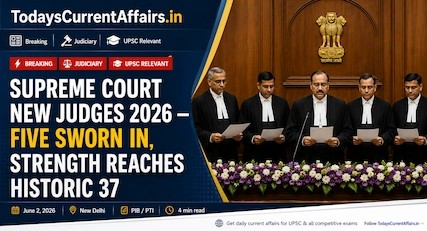
Supreme Court New Judges 2026 — Five Sworn In, Strength Reaches Historic 37
Supreme Court new judges 2026 — Chief Justice of India Surya Kant administered the oath of office to five new judges on June 2, taking the court's working strength to 37, the highest in its history. One vacancy remains.
What Happened?
Supreme Court new judges 2026 — On June 2, 2026, Chief Justice of India (CJI) Surya Kant presided over the swearing-in ceremony at the Supreme Court premises in New Delhi. Five judges took the oath of office, raising the court's working strength from 32 to 37 — the highest in the history of the apex court.
The appointments came shortly after the Union government increased the sanctioned strength of the Supreme Court through the Supreme Court (Number of Judges) Amendment Ordinance, 2026, exercising the President's power under Article 123 of the Constitution.
Who Are the 5 New Supreme Court Judges?
The following five judges were sworn in as judges of the Supreme Court of India:
| # | Judge | Previous Position |
|---|---|---|
| 1 | Justice Sheel Nagu | Chief Justice, Punjab & Haryana High Court |
| 2 | Justice Shree Chandrashekhar | Chief Justice, Bombay High Court |
| 3 | Justice Sanjeev Sachdeva | Chief Justice, Madhya Pradesh High Court |
| 4 | Justice Arun Palli | Chief Justice, High Court of J&K & Ladakh |
| 5 | Justice V.S. Mohana | Senior Advocate |
Notable: Justice V.S. Mohana is the only non-judicial appointee among the five — elevated directly from practice as a Senior Advocate, following a tradition of bar-to-bench elevations in the Supreme Court.
Supreme Court Strength — Key Numbers
| Parameter | Figure |
|---|---|
| Previous sanctioned strength (excl. CJI) | 33 |
| New sanctioned strength (excl. CJI) | 37 |
| Total sanctioned strength (incl. CJI) | 38 |
| Working strength after swearing-in | 37 |
| Vacancies remaining | 1 |
| Increase in sanctioned strength | +4 judges |
Background — Why Were New Judges Appointed?
The Union government promulgated the Supreme Court (Number of Judges) Amendment Ordinance, 2026 last month, increasing the court's sanctioned strength from 34 to 38 judges including the CJI — an addition of four judges.
This expansion created six new vacancies — four from the increase in sanctioned strength plus two pre-existing ones. Monday's appointment of five judges filled five of these six positions, leaving one position yet to be filled.
The move is widely seen as an effort to address the growing backlog of cases pending before the apex court, which runs into lakhs of matters.
Constitutional & Legal Provisions — Key for UPSC
Article 124 — Establishment of Supreme Court
Article 124 of the Indian Constitution provides for the establishment and constitution of the Supreme Court of India. It empowers Parliament to fix and regulate the number of judges by law — which is exercised through the Supreme Court (Number of Judges) Act, 1956.
Supreme Court (Number of Judges) Act, 1956
This Act governs the sanctioned strength of the Supreme Court. It has been amended multiple times over the years to increase the number of judges in line with the rising workload. The latest amendment increases the strength to 38 (including CJI).
Article 123 — Ordinance-Making Power of the President
The increase in sanctioned strength was effected through an Ordinance — exercising the President's power under Article 123, which allows the President to promulgate ordinances when Parliament is not in session. Such ordinances must be approved by Parliament within six weeks of its reassembly.
Polity: Appointment of SC judges (Collegium system), Article 124, Supreme Court (Number of Judges) Act 1956 and its amendment, composition and jurisdiction of SC
Governance: Judicial reforms, pendency of cases, judicial independence, bar-to-bench elevations
Polity: Article 123 — Ordinance-making power of the President; when Parliament is not in session
Current Affairs: Names of new judges, CJI Surya Kant, sanctioned vs working strength figures (37 and 38), date of swearing-in
Ethics: Independence of judiciary, accountability, role of senior advocates in bar-to-bench elevation
Topics: Judicial pendency in India, need for expansion of SC strength, Collegium system reforms
The swearing-in of five Supreme Court new judges in 2026 marks a landmark moment in Indian judicial history. With the working strength now at 37 — the highest ever — the apex court is better positioned to tackle its mounting case backlog.
The use of the Ordinance route to expand the sanctioned strength, and the bar-to-bench elevation of Justice V.S. Mohana, are particularly noteworthy aspects of this development. One vacancy still remains to be filled.
For UPSC aspirants, this news is relevant across GS Paper II (Polity & Governance), Prelims current affairs MCQs, and constitutional provisions related to the Supreme Court.
Frequently Asked Questions (FAQs)
How many new judges were sworn into the Supreme Court in June 2026?
What is the current sanctioned strength of the Supreme Court in 2026?
Who are the 5 new Supreme Court judges sworn in 2026?
Who is the current Chief Justice of India (CJI) in 2026?
Which article of the Constitution deals with the Supreme Court's composition?
What is the Supreme Court (Number of Judges) Amendment Ordinance, 2026?
📰 Get daily current affairs for UPSC & all competitive exams
Follow TodaysCurrentAffairs.in →🚀 Join Our Exam Preparation Community
Stay ahead in your preparation with daily exam-focused content, curated for UPSC, TNPSC, SSC and other competitive exams.
📲 Telegram Community
👉 5,000+ active aspirants
👉 50+ MCQs reflected in recent exams (2024 & 2025)
👉 Daily quizzes, PYQs & revision content
👉 Positive feedback from prelims-cleared candidates
▶️ YouTube Channel
👉 Daily Current Affairs videos
👉 Based on The Hindu, PIB, Government sources
👉 PYQ-focused explanation (UPSC, TNPSC)
👉 Short, exam-oriented analysis
📸 Instagram Updates
👉 Daily quick revision posts
👉 Exam facts & current affairs snippets
💼 LinkedIn
👉 Professional updates & exam insights
+Trusted by thousands of aspirants preparing for competitive exams